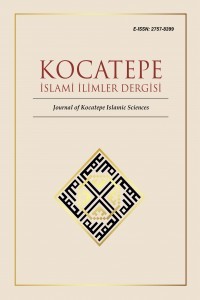
Journal of Kocatepe Islamic Sciences aims to share scientific studies on Social Sciences, Humanities and Theology fields research articles.
The scientific researches can be published in Turkish, Arabic and English.
The target group of the Journal consists of academicians, professionals, students, related and academic bodies, and institutions.
One study of an author can be published at most in an issue.
Article acceptance dates of the journal published in June and December are between 1 January and 1 March for the June issue and 1 July and 1 September for the December issue. Applications received after these dates will not be accepted. If the number of articles reaches a sufficient level, the process of accepting articles may be closed before these dates.
Click here for sample Article Writing Template.
Cilk here for Conflict of Interest and Author Contributions Statement.
Basic principles
Template featuresPage numbers should not be used.
Footnote: special indentation hanging 0,5 cm, spacing before and after 0 pt, line spacing single, font size 8pt.
Bibliograpy: special indentation hanging 1 cm, spacing before and after 0 pt, line spacing single, font size 10 pt.
Text fonts should be in Cambria Font for Turkish and English, Tradational Naskh for Arabic
d) Responsibilities of the Publisher
Our journal makes the editors responsible for all the works included in the process. The editor carries out the necessary measures to prevent political or economic gains from the work done in the journal. Our journal is committed to independence in the creation of editorial decisions. The responsibility of the editors to take the necessary precautions regarding academic misconduct and plagiarism related to the process is also under the commitment of our journal. Journal of Kocatepe Islamic Sciences publishing the works under the Creative Commons Attribution-NonCommercial 4.0 International (CC BY-NC 4.0) license and authors retain the copyright to their work.
The reader can make a complaint by sending an e-mail to kiid@aku.edu.tr when he notices an important mistake or mistake in an article published in the Journal of Kocatepe Islamic Sciences, or has any complaints about the editorial content (plagiarism, duplicate articles, etc.). We welcome complaints as they will provide an opportunity for us to improve, and we aim to respond quickly and constructively.
Editorial oversight and processing concerning special issues
A special issue can be published in the journal once a year upon the request of the Editorial Board. Manuscripts sent for inclusion in a special issue are first subjected to editorial review. Then it is examined in terms of compliance with the writing rules of the journal and similarity is scanned to prevent plagiarism. After these stages, it is taken into the peer review process in which the double-blind model is used. Articles sent to the special issue will also be evaluated in accordance with the principles we announced on the "Peer-Review Processes" page.
A maximum of 20% of the authors (excluding the editor-in-chief) in the editorial boards of each issue are accepted. Authors cannot interfere in any stage of the article evaluation process and publication. Title of the article should be written in Turkish and English, and the authors’ names, surnames, academic titles, institutions they work in, and ORCID information should be specified. Additionally, the authors’ contact information (e-mail addresses) should be given completely.
The length of a research article should be at least 3000 and no more than 9000 words (including Turkish and English abstracts and bibliography). At the beginning of the article, there should be Turkish and English Abstracts consisting of 250-300 words, at least 5 Turkish and English Keywords, Turkish and English titles and bibliography prepared in accordance with the Isnad Citation Style 2nd version.
One study of an author can be published at most in an issue.
Article acceptance dates of the journal published in June and December are between 1 January and 1 March for the June issue and 1 July and 1 September for the December issue. Applications received after these dates will not be accepted. If the number of articles reaches a sufficient level, the process of accepting articles may be closed before these dates.
All article types (including symposium papers, book reviews) sent to be published are gone through the editorial board review, Pre-Control and Peer-Review Processes.
In the evaluation of the submitted articles, academic objectivity and scientific quality are the most important criteria.
Articles are first examined by the editorial board for compliance with the journal principles. Studies that are not deemed suitable for inclusion in the journal are returned to the author.
The articles that the editorial board deems appropriate to be included in the process are subject to Pre-control review.
Articles are passed through the plagiarism control process through intihal.net software. The similarity rate in the plagiarism detection policy is 20%. The studies that are considered as inadequate in the pre-control process are returned to the author by the Editorial Board before the referee process/ peer-review process . For the studies that are considered as adequate in the pre-control process, the peer-review process is initiated or these studies are sent to the authors to correct the deficiencies.
A study which cannot pass through this process even though it is examined one time during the pre-control process is returned to the author and does not put into process again in the same publication period.
For the studies which pass through the pre-control process, the evaluation process in which at least two reviewers serve within the frame of double-sided blind reviewer principle is started. The names of the reviewers are kept confidential. If one of the reviewer reports is positive and the other is negative, the article may be sent to a third reviewer/ referee or the Editorial Board may make a final decision by examining the reviewer reports. The authors consider the criticism and suggestions made by the reviewer and Editorial Board. Authors have the right of opposition and defence for their ideas on the condition that the authors disagree with the idea of reviewer.
In detecting plagiarism, it is confirmed with the intihal.net software that articles have not been published before and do not include plagiarism. The similarity rate in the plagiarism detection policy is 20%.
Also, it is demanded from the authors to fill out the form for Conflict of Interest and Author Contributions Statement .
Open Access Policy
Every single study published in the Journal of Kocatepe Islamic Sciences has been licenced by Creative Commons International Licence (CC-BY-NC 4.0). See open access policy.
Copyright
Authors publishing with Journal of Kocatepe Islamic Sciences retain the copyright to their work, licensing it under the Creative Commons Attribution-NonCommercial 4.0 International (CC BY-NC 4.0) license.
Journal of Kocatepe Islamic Sciences does not ask for processing and printing charge from the authors.
Emin Uz;
1983 yılında Kütahya’nın Domaniç ilçesinde doğdu. İlköğrenimini köyünde tamamladıktan sonra İzmir’de hafızlığını ikmal etti. 1996-2003 tarihleri arasında Tavşanlı Anadolu İmam Hatip Lisesi’nde ortaöğrenimini tamamladı. 2003-2007 yılları arasında Uludağ Üniversitesi İlahiyat Fakültesi Din Kültürü ve Ahlak Bilgisi Öğretmenliği Bölümü’nde lisans eğitimini tamamladı. 2012 yılında Uludağ Üniversitesi Sosyal Bilimler Enstitüsü Hadis Anabilim dalında yüksek lisansını; 2017 yılında da Arap Dili ve Belagatı Anabilim Dalında doktorasını tamamladı. Yaklaşık 10 yıl kadar Diyanet İşleri Başkanlığın’da imam-hatip, vaiz ve ilçe müftüsü olarak görev yaptı.
2013 yılında araştırma görevlisi olarak başladığı Afyon Kocatepe Üniversitesi İslami İlimler Fakültesi Arap Dili ve Belagatı Bölümüne, 2017 yılında Dr. Öğr. Üyesi olarak atandı. Halen aynı üniversitede öğretim üyeliğine devam etmektedir. Evli ve 4 çocuk babasıdır
Eserleri:
Kitapları:
• Hadiste İsnadın Doğuşu
• Kur’ân-ı Kerîm Müdafaası: Te'vîlü Müşkili'l-Kur'ân
• Arap Kültüründe Bilginin İntikal Seyri
• Bir Mizah Antolojisi Örneği: Cevâmiu'l-Hikâyât
• Sufi Mizahı
• İslâm’da Aile
• 14. yy. Osmanlı Dönemi İlk Yazılı Edebî Metinlerinden TÂBİRNÂME
• Türk İslâm Kültüründe Rivâyet Geleneği
• Türk İslâm Edebiyatındaki İstiâre Sanatına Kur'ân Temelli Yaklaşım
• Kinâye ve Ta’rîz Yoluyla Edebî Dili Tahkîrden Kurtarma
Makale/Bildiri:
• Bir Kardeşlik ve Vefa Örneği Hz. Ebubekir
• Din Öğretimi Sürecinde Mizah Yönteminin Kullanımı
• Arap Nevâdir Eserleri Örnekliğinde Mizahın Toplumsal ve Siyasal İşlevi
• İsnâd Sisteminin Arap Edebiyatında Kullanımı
• Klasik Doğu ve Batı Edebiyatındaki Cimri Karakteri….
1985 yılında Bursa’da doğdu. 2003 yılında Bandırma Anadolu İmam-Hatip Lisesinden mezun oldu. Lisans eğitimini 2007 yılında Bursa Uludağ Üniversitesi İlahiyat Fakültesinde tamamladı. 2011 yılında aynı üniversitenin Sosyal Bilimler Enstitüsü Felsefe ve Din Bilimleri Bölümünde yüksek lisansını, 2017 yılında doktorasını tamamladı. 2013-2020 yılları arasında Afyon Kocatepe Üniversitesi İslamî İlimler Fakültesi İslam Felsefesi Anabilim Dalında araştırma görevlisi olarak çalıştı. Halen aynı üniversitenin Fen-Edebiyat Fakültesi Felsefe Bölümü İslam Düşüncesi Anabilim Dalında görev yapmaktadır. Fârâbî ve İbn Sînâ felsefesi, Klasik dönem İslam felsefesinde nefis teorileri, İslâm siyaset düşüncesi ilgilendiği konular arasındadır.
Web
Irfan Erdogan currently works at the Religious Education Department at Necmettin Erbakan University. Irfan does research in Teacher Education, Critical Thinking, Reflective Thinking and Teaching Ethics. Their most recent publication is 'Intercultural Sensitivity and Ethnocentrism Levels of Theology Students in a Turkish University Sample'.
Web
İlköğretimini doğduğu Sivas şehrinde tamamlamış, ardından Sivas/Akıncılar İlçe Müftülüğüne bağlı Eskibağ Kur’an Kursu’nda hafızlığını ikmâl etmiştir. Klasik usulde beş yıllık İslâmî ilimler tedrisatından sonra 2005-2006 yılları arasında Şam’da AlFateh Institute’de eğitim görmüş, 2015 yılında Anadolu Üniversitesi İlahiyat Önlisans programından, 2016 yılında da İstanbul Üniversitesi Edebiyat Fakültesi Arap Dili ve Edebiyatı bölümünden mezun olmuştur. 2016 yılında İstanbul Üniversitesi Sosyal Bilimler Enstitüsü’ne bağlı olarak Arap Dili ve Edebiyatı alanında Yüksek Lisans eğitimine başlamış ve 2018 yılında “Hadislerde el-Uslûbu’l-Hakîm Sanatı ve Buhârî Örneği” adlı teziyle yüksek lisans eğitimini tamamlamıştır. Aynı yıl İstanbul Üniversitesi Sosyal Bilimler Enstitüsü’ne bağlı olarak Temel İslam Bilimleri Arap Dili ve Belagati alanında doktoraya başlamış ve “Arap Dili ve Belagatinde “Ecvibe-i Müskite” Üslubu: İbn Ebî ‘Avn Örneği” adlı tez çalışmasını ortaya koymuştur. 2006-2014 yılları arasında çeşitli kurum ve kuruluşlarda eğitmenlik yapmış, 2014-2017 yılları arasında ise Milli Eğitim Bakanlığı’nda Arapça öğretmeni olarak çalışmıştır. 2017 yılından itibaren ise Afyon Kocatepe Üniversitesi İlahiyat Fakültesi Arap Dili ve Belagati alanında görev yapmaktadır.
1990 yılında İstanbul’da dünyaya gelen yazar, ilk ve orta okulu İstanbul’da tamamladı. 2008 yılında Kartal Anadolu İmam-Hatip Lisesinden 2012 senesinde Uludağ Üniversitesi İlahiyat Fakültesinden mezun oldu. Aynı yıl Süleyman Demirel Üniversitesi İlahiyat Fakültesi İslam Mezhepleri Tarihi bilim dalına araştırma görevlisi olarak atandı. 2015 yılında "Haşviyye Fırkası" isimli yüksek lisans ve 2021 yılında "Hanbelîlik-Eş‘arîlik İlişkisi" adlı doktora tezini hazırladı. İslam düşüncesinin teşekkülü, Hanbelîlik, Eş‘arîlik ve mezhepler arası ilişki gibi konularda çalışmalar yürütmektedir. İngilizce ve Arapça bilen yazar, evli ve iki çocuk babasıdır.
Afyon Kocatepe University, Department of Islamic History and Arts, Head of Turkish Religious Music Department
1990 yılında İstanbul’da dünyaya gelen yazar, ilk ve orta okulu İstanbul’da tamamladı. 2008 yılında Kartal Anadolu İmam-Hatip Lisesinden 2012 senesinde Uludağ Üniversitesi İlahiyat Fakültesinden mezun oldu. Aynı yıl Süleyman Demirel Üniversitesi İlahiyat Fakültesi İslam Mezhepleri Tarihi bilim dalına araştırma görevlisi olarak atandı. 2015 yılında "Haşviyye Fırkası" isimli yüksek lisans ve 2021 yılında "Hanbelîlik-Eş‘arîlik İlişkisi" adlı doktora tezini hazırladı. İslam düşüncesinin teşekkülü, Hanbelîlik, Eş‘arîlik ve mezhepler arası ilişki gibi konularda çalışmalar yürütmektedir. İngilizce ve Arapça bilen yazar, evli ve iki çocuk babasıdır.
