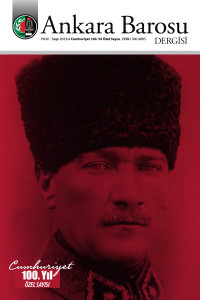
The Journal of Ankara Bar Association, which began publication in the 1940s, is recognized as one of the well-established and prestigious periodicals in Turkish legal literature.
The Journal aims to contribute to the development of law by publishing high-quality and original academic studies across all fields of law. In this regard, it particularly encourages contributions involving doctrinal analysis, comparative legal studies, and interdisciplinary approaches, as well as works addressing the development of the Turkish legal system from both national and international perspectives.
In line with its academic mission, the Journal of Ankara Bar Association seeks to provide a platform for critical discussion of contemporary legal issues, to promote methodological rigor, and to strengthen the dissemination of knowledge among academics, practitioners, and policymakers. In this context, the Journal places importance not only on studies analyzing positive law, but also on research examining the theoretical foundations and socio-legal dimensions of law.
The scope of the Journal encompasses all areas of law within the framework of public and private law.
JOURNAL OF ANKARA BAR WRITING RULES
1. The writing language is Turkish and English. Manuscripts submitted to the journal are proofread by the Editors/Assistant Editors. The spelling, punctuation and abbreviations in Turkish articles are based on the latest edition of the TDK Spelling Guide.
2. Articles to be submitted to the Journal of the Ankara Bar Association should be in “Microsoft Word” program (.doc or .docx format), A4 page layout should be normal, page structure; 2.5 cm from the top, 2.5 cm from the bottom, 2.5 cm from the left, 2.5 cm from the right, binding margin 0, header 1.25 cm, footer 1.25 cm. Page numbers should be shown at the bottom center.
3. Font should be Times New Roman, 12 pt, normal style; line spacing should be 1.5 and then 6 pt. Footnotes should be in Times New Roman, 10 pt, line spacing 1. Main text and footnotes should be justified.
4. Turkish and English abstracts (not exceeding 400 words in total); the title of the article in both languages and five keywords should be added at the beginning of the article.
The order should be Turkish Title > Abstract > Keywords > English Title > Abstract > Keywords.
If the article is submitted in English; English Title > Abstract > Keywords > Turkish Title of the Article > Abstract > Keywords.
5. Titling cannot exceed 5 levels (3 levels is recommended). Titling should be done as follows:
I. FIRST LEVEL HEADING ALL CAPITAL LETTERS AND BOLD
A) SECOND LEVEL HEADING ALL CAPITAL LETTERS AND BOLD
1- Third Level Subheading Only First Letters Capitalized and Bold
a) Fourth Level Subheading Only First Letters Capitalized and Bold
i. Bottom Title Only First Letters Capitalized, Bold and Italicized (Please do not use unless necessary)
6. Citations are not shown in the text. The footnote number in the text must be given before the punctuation marks.
7. Citations and bibliography are based on the Chicago system. The details of this system can be found on the website (https://www.chicagomanualofstyle.org/).
In order to create a standard in the citation examples of all different types of writings such as books, edited books, e-books, translated books, book chapters, journal articles, papers, reports, reports, encyclopedia articles, book introductions, theses, newspaper articles, interviews, web content, blog posts, etc. and in the use of legislation, court decisions, abbreviations and punctuation marks; please follow the Chicago system sensitively.
Journal of Ankara Bar Association aims to comply with the guidelines, policies, core practices, and recommendations established by various organizations, including the Committee on Publication Ethics (COPE) and the Principles of Transparency and Best Practice in Scholarly Publishing (joint statement by COPE, DOAJ, OASPA, and WAME). These guidelines are designed to promote transparency, integrity, and best practices in scholarly publishing.
Ethics Committee Approval
Our journal requires that studies conducted in fields necessitating ethics committee approval must have obtained the relevant ethics committee decision.
Accordingly, authors must indicate the date and reference number of the ethics committee approval on the first or last page of the manuscript.
In line with the regulations introduced by TR Dizin (ULAKBİM) as of 2020, studies lacking ethics committee approval are not considered for evaluation in our journal.
Corrections, Retractions, and Expressions of Concern
Editors may consider issuing a correction if minor errors that do not affect the findings, interpretations, or conclusions of a published article are identified.
In cases of major errors or violations that invalidate the findings and conclusions, editors should consider retracting the article.
COPE guidelines are followed with regard to corrections, retractions, and expressions of concern.
Conflicts of Interest
Our journal guarantees that the publication process is completed independently and impartially, taking into account any conflicts of interest among authors, reviewers, and editors.
Use of Artificial Intelligence
The use of artificial intelligence in submitted manuscripts is permissible for processes that do not affect the originality of the work, such as literature review or language editing.
For manuscripts involving the use of artificial intelligence, authors are expected to inform the journal at the submission stage. All responsibility regarding the use of artificial intelligence rests with the authors.
Ethical Responsibilities of the Editorial Board
Ethical Responsibilities of Authors
Authors are advised to avoid the following forms of plagiarism and ethical misconduct:
In cases of suspected ethical violations, the Editorial Board will follow COPE guidelines to ensure that concerns are addressed in a fair, transparent, and consistent manner.
Ethical Responsibilities of Reviewers
Post-Publication Corrections and Retraction Policy
All post-publication correction requests are subject to editorial review. The Editorial Board evaluates the necessity and appropriateness of corrections based on the nature of the error, its impact on the article, and supporting evidence. If approved, corrections are implemented in the journal archive. The journal follows COPE guidelines.
Retraction decisions are made in cases of serious ethical violations, including plagiarism, data fabrication, fraudulent authorship, or publication without co-author consent. Retraction notices include the following elements:
Submission and publication of articles to the Journal of Ankara Bar Association is free of charge.
No royalties are paid for published articles.