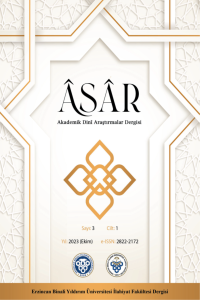
2026
Publication Type
Deprem Hermenötiği: Kognitif Yaklaşım Çerçevesinde Mukayeseli Bir Analiz
Gökmenzâde’nin İşâret-nümâ Adlı Deprem Risalesindeki Dinî-Tasavvufi Mesajlar
Deprem ve Travma Bağlamında Türkiye Yüzyılı Maarif Modeli Fıkıh Dersi Öğretim Programında Sosyal-Duygusal Öğrenme Becerileri ve Değerler
Kur’ân’da Deprem ve Doğal Afetlerin İlâhî Fiil Bağlamında İncelenmesi
Erzincan Depremleri ve Dinî Anlamlandırma: Müslüman ve Gayrimüslim Kaynaklarda Nakil ve Yorum
Doğal Afet Bilinci ve Din Eğitimi İlişkisi Bağlamında Din Kültürü ve Ahlak Bilgisi Derslerinin Değerlendirilmesi
Deprem Aktivitesi ve Kötülük Problemi: Doğal Süreçler Bağlamında Teodise Tartışması
Afet Bilincinin İnşasında Tedbir ve Tevekkül Bütünlüğü: 6 Şubat Depremleri ve Bütüncül Din Eğitimi Modeli
Deprem Sonrası Travma ve Dini Başa Çıkma Mekanizmaları: Psiko-sosyolojik Bir Derleme
Stoacılığın Afet-Erdem İlişkisine Yaklaşımı Üzerine Birkaç Not
AIMS
ÂSÂR Academic Journal of Religious Studies aims to publish original and high-quality academic studies based on scientific methodology that address current developments in the fields of religion, philosophy, history, sociology, psychology, and related areas within the social sciences.
The journal seeks to contribute to the production and dissemination of knowledge at both national and international levels. It also aims to establish an interdisciplinary scholarly platform for discussions where religious thought intersects with various academic disciplines.
SCOPE
ÂSÂR Academic Journal of Religious Studies publishes academically rigorous and original research articles, translated works, research notes, book reviews, and scholarly meeting evaluations within all disciplines related to theology.
The journal prioritizes interdisciplinary approaches and studies that are connected to contemporary issues in the fields of religion, philosophy, history, sociology, and psychology within the social and human sciences.
________________________________________
1. Publication Principles and Peer Review Process
ÂSÂR operates under a double-blind peer review system.
All submissions are initially evaluated in terms of compliance with submission guidelines and journal scope.
Submissions deemed suitable are sent to at least two expert reviewers in the relevant field.
The final decision regarding publication is made by the Editorial Board based on reviewer reports.
________________________________________
2. Open Access Policy
The journal is published online and follows an open-access model.
________________________________________
3. Publication Ethics
The Editorial Board of the journal fully adopts and adheres to the Committee on Publication Ethics (COPE) standards and the Scientific Research and Publication Ethics Directive of the Council of Higher Education (YÖK) in Türkiye.
Key Aspects of COPE Standards:
• Purpose and Vision:
o COPE aims to promote transparency, integrity, and fairness in academic publishing.
o It provides guidance on addressing ethical issues that may arise during the publication process and encourages the application of ethical principles.
• Responsibilities of Stakeholders:
o Authors:
Must ensure originality and accuracy of their work and avoid plagiarism.
Must provide complete citation of sources and ensure transparency in data analysis and reporting.
Must declare any potential conflicts of interest.
o Editors:
Must assess submissions based on scientific merit, originality, and ethical standards.
Must ensure impartiality and confidentiality when assigning reviewers.
In cases of ethical breaches, editors are responsible for initiating necessary actions such as issuing corrections, retractions, or expressions of concern.
o Reviewers (Peer Review Process):
Conduct double-blind peer reviews with objectivity and thoroughness.
Provide constructive and justified evaluations.
Maintain confidentiality and impartiality throughout the process.
• Originality, Plagiarism, and Conflict of Interest:
o COPE has strict policies against plagiarism, data manipulation, and improper citation.
o All contributions and financial relationships must be disclosed transparently.
• Peer Review and Decision-Making Mechanisms:
o The peer review process must be fair, objective, and transparent.
o Reviewer and author identities remain confidential, and review reports should be detailed and clear.
o In cases of ethical misconduct, necessary actions such as public disclosure, corrections, or retraction of articles may be undertaken.
• Training and Resources:
o COPE provides extensive resources such as guidelines, flowcharts, and e-learning modules to support ethical practices.
• Approach to Problem Solving:
o Rather than investigating individual cases, COPE offers a framework for ethical problem resolution and experience sharing among members to develop best practices.
________________________________________
4. Target Audience
• Academics
• Postgraduate researchers
• Interested undergraduate students
• Professionals
• Relevant academic and professional institutions
________________________________________
5. Types of Publications
• Original research articles
• Review articles
• Book and academic meeting reviews
- Book Review Policy
Our journal publishes book reviews (800–2000 words) on works published within the last five years that demonstrate the potential to make a substantive contribution to the relevant field of scholarship. Works considered for review are expected to have been published within the past five years and to adhere to scholarly standards, employing sound methodology and presenting an original thesis or methodological contribution. Introductory undergraduate textbooks, exam-preparation materials, and popular publications are not accepted for review. However, graduate-level textbooks that offer significant theoretical or methodological contributions to the field may be considered at the discretion of the Editorial Board. Translations are accepted only if they are published in the relevant language for the first time and provide an original academic contribution. Conference proceedings that have not undergone peer review and publications of uncertain scholarly quality are excluded from consideration. Submissions involving any conflict of interest will not be processed. Book reviews must go beyond mere summary and include critical analysis as well as a clear positioning of the work within the existing literature.
• Translated articles (with official permission)
• Bibliographic studies
• Academic discussion papers
________________________________________
6. Subject Categories
• Social Sciences: Sociology, Psychology
• Humanities: History, Philosophy, Religion, Theology
• LCC Subject Headings: Philosophy. Psychology. Religion – General Philosophy
________________________________________
7. Keywords
Religion, Philosophy, History, Sociology, Psychology
________________________________________
8. Submission Calendar
• Article submissions open on April 15.
• The deadline for submissions is August 31.
• As the journal is published annually, the submission system will be closed once the number of submissions reaches 40.
________________________________________
9. Scientific Method Principle
Submissions must be based on sound scientific methodology. The sample used in the research should represent a sufficiently large and diverse target population. Studies based solely on samples from a single university must clearly state the limited generalizability of the results. The population-sample relationship must be scientifically justified with rigor and clarity.
________________________________________
10. Publication Date
The journal is published once a year, at the end of October, and accepts academic works written in Turkish, English, and Arabic.
Publication Month: October
________________________________________
Writing Guidelines
ÂSÂR Academic Journal of Religious Studies – Submission Guidelines
________________________________________
1. Publication Aim and Language
ÂSÂR aims to contribute to the dissemination of knowledge at national and international levels by publishing original research articles in Turkish, English, and Arabic, addressing current issues in fields such as religion, philosophy, history, sociology, and psychology.
________________________________________
2. Publication Period and Submission Timeline
- The journal is published once a year in October, exclusively in an online and open-access format.
- The submission period opens annually on April 15th and concludes on August 31st.
- A maximum of 40 manuscript submissions are accepted per publication cycle; submissions will be closed once this limit is reached.
- The average duration of the evaluation process is 60 days. Each manuscript undergoes the following review stages:
- Initial Formatting Review (Manuscripts that do not conform to the Âsâr Article Template may be returned to the author for revision).
- Field Editor Review and Evaluation.
- Peer review by at least two field referees (double-blind).
- Review by one language editor.
- Review by one final proofreader.
________________________________________
3. Submission Requirements
• Submitted articles must be unpublished, not under review elsewhere, and approved by all listed authors.
• An author may only submit one article per issue.
________________________________________
4. Copyright and Licensing
• All authors must sign the Copyright Agreement Form in blue ink and upload it as a single PDF file to the system.
• All published works are licensed under CC BY-NC 4.0. Copyright is retained by the authors.
• Changes to author name(s), order, or contribution are only permitted with the consent of all authors after acceptance.
________________________________________
5. Formatting and Technical Specifications
- Articles must be prepared in Microsoft Word format using the official ÂSÂR Article Template.
- Font: Gentium Plus
- Main text: 10.5 pt | Footnotes: 8.5 pt
- Word limit: Maximum 10,000 words
- Block Quotation: Quotations exceeding forty words should not be reinserted into the main text using quotation marks. Instead, they must be presented as a separate paragraph in block quotation format, without quotation marks. Such quotations should be indented 2.5 cm from both the left and right margins and formatted in a font size one point smaller (9.5 pt).
Note: Furthermore, quotations should not be unnecessarily repeated within the text, and the boundaries of direct citation must be observed with particular care.
________________________________________
6. Citation and Referencing Style
• The journal uses the ISNAD Citation Style (2nd Edition).
• Manuscripts not conforming to ISNAD will be returned for revision.
👉 ISNAD Guide
________________________________________
7. Sectioning and Headings
Suggested structure:
• Introduction
•
1. Main Heading
o 1.1. Subheading
1.1.1. Sub-subheading
•
2. Main Heading
o 2.1. Subheading
2.1.1. Sub-subheading
• Conclusion
• Appendix
• References
________________________________________
8. Abstract, Keywords, and Highlights
Each article must include the following:
• A 250–300 word abstract in both Turkish and English
• At least 5 keywords in Turkish and English
• A "Highlights" section with at least 5 bullet points
o Each sentence should not exceed 1.5–2 lines
👉 Sample Highlights
________________________________________
9. Article Processing Charges
ÂSÂR is completely free of charge.
• No submission, evaluation, or publication fees are charged at any stage.
________________________________________
10. Ethical Guidelines and Permissions
• The journal adheres fully to COPE Publication Ethics and the Council of Higher Education (YÖK) Scientific Research and Publication Ethics Directive.
• For studies requiring ethics committee approval, the following details must be clearly stated:
o Name of the committee, date, and approval number
o Ethics statement in the Methods section and on the first/last page
o For case studies, informed consent information must be provided
👉 Click here for detailed information on ethics approval
________________________________________
11. Population–Sample Representativeness
• The sample used in the study must accurately represent the target population.
• Limitations on generalizability should be explicitly noted, especially in studies with samples drawn from a single university or department.
________________________________________
12. Ethical Statement and Acknowledgments
Before the reference section, include the following subheadings:
• Ethical Statement
• Author Contribution
• Funding and Acknowledgments
• Conflict of Interest Statement
________________________________________
13. Author and Affiliation Details
On the first page of the article, author names and institutional affiliations must be presented in accordance with the ISNAD citation format.
👉 ISNAD Author Information Format
👉 ÂSÂR Article Template
________________________________________
ETHICAL PRINCIPLES AND PUBLICATION POLICY
ÂSÂR Academic Journal of Religious Studies adheres to national and international standards in research and publication ethics. It complies with the Press Law (a), the Law on Intellectual and Artistic Works (b), and the Higher Education Institutions Scientific Research and Publication Ethics Directive (c). Furthermore, it has adopted the International Ethical Publishing Principles (d) published by the Committee on Publication Ethics (COPE), the Directory of Open Access Journals (DOAJ), the Open Access Scholarly Publishers Association (OASPA), and the World Association of Medical Editors (WAME).
- a) Press Law
- b) Law on Intellectual and Artistic Works
- c) Higher Education Institutions Scientific Research and Publication Ethics Directive
- d) Principles of Transparency and Best Practice in Scholarly Publishing
Studies Based on Surveys and Interviews
ÂSÂR Academic Journal of Religious Studies has embraced the “Code of Conduct and Best Practice Guidelines for Journal Editors” and the “Code of Conduct for Journal Publishers” of the Publication Ethics Committee (COPE) to ensure ethical reliability in scholarly periodical publishing. In this context, the following points must be observed for all submitted studies:
- For research requiring ethics committee approval in all branches of science, (an ethics committee approval must have been obtained, this approval should be stated in the article, and the approval document must be provided).
- For research requiring ethics committee approval, information regarding the approval (name of the committee, date, and reference number) should be included in the methodology section as well as on either the first or last page of the article. In case studies, information that a signed informed consent form has been obtained from volunteers should be included in the article.
Special Issue Publication Policy
- A special issue may be published once a year upon the request of the Editorial Board. Articles submitted for the special issue first undergo an Editorial pre-check. Then, they are examined for compliance with the journal’s writing rules and are checked for plagiarism. After these stages, they move on to a double-blind peer review process.
Corrections, Retractions, Expression of Concern
- Editors may consider publishing a correction if minor errors that do not affect the findings, interpretations, or conclusions are detected in a published article.
- When major errors/violations are detected that invalidate the findings and conclusions, editors should consider retracting the article.
- If there is a possibility that the research or publication has been misused by authors; there is evidence that the findings are unreliable, and the authors’ institutions have not investigated the incident; or there is suspicion that the investigation is unjust or inconclusive, the editors should consider issuing an expression of concern.
- For corrections, retractions, or expressions of concern, COPE and ICJME guidelines are taken into account.
Plagiarism Action Plan and Journal Measures
The journal respects intellectual property, aiming to protect and encourage authors’ original works. Articles containing plagiarism violate standards of quality, research, and innovation. Therefore, all authors submitting articles to the journal are expected to comply with ethical standards and refrain from any form of plagiarism. If plagiarism is suspected in a submitted or published paper:
- The paper is first examined by the journal’s Ethics Editor.
- Then, the Editorial Board reviews the work.
- Subsequently, the journal contacts the author(s) within two weeks to obtain an explanation.
- If no response is received within the specified time, the journal will contact the university to which the author is affiliated and request an investigation.
For published papers found to include plagiarism, the journal will take the following serious measures:
- The journal will immediately contact the author’s institution so that decisive action can be taken against the relevant author(s).
- The journal will remove the PDF copy of the published article from the website and deactivate all links to the full text of the article. The label “Plagiarized Article” will be added to the title of the published article.
- The journal will deactivate the author’s account and reject any future submissions from the author for a period of 3 years.

Plagiarism Checks in This Journal
- Articles that pass the initial editorial check are scanned for plagiarism using TURNITIN.
- If plagiarism/self-plagiarism is detected, the authors are notified.
- Editors may run plagiarism checks at various stages of the review or production process, if necessary.
- High similarity rates can lead to rejection before or even after acceptance. A similarity rate below 15% is expected.
Publication Ethics Policy
- This journal checks for plagiarism in all manuscripts under review. The journal adheres to national and international standards regarding research and publication ethics. It complies with the Press Law, the Law on Intellectual and Artistic Works, and the Higher Education Institutions Scientific Research and Publication Ethics Directive. In addition, it has adopted the International Ethical Publishing Principles published by the Committee on Publication Ethics (COPE), the Directory of Open Access Journals (DOAJ), the Open Access Scholarly Publishers Association (OASPA), and the World Association of Medical Editors (WAME).
1. Authorship
- The reference list must be complete.
- No plagiarism or fabricated data should be included.
- Attempting to publish the same research in multiple journals is strictly prohibited; authors must adhere to research and publication ethics.
Violations of research and publication ethics include the following:
- a) Plagiarism: Presenting someone else’s ideas, methods, data, practices, writings, or works, in part or in full, as one’s own without providing a citation in accordance with scientific rules.
- b) Fabrication: Producing data not based on research, organizing or modifying a submitted or published paper using fabricated data, reporting or publishing such data, or presenting a study that was not carried out as if it were conducted.
- c) Falsification: Falsifying research records and obtained data, showing methods, devices, or materials not used in the research as if they were used, ignoring data that do not fit the research hypothesis, manipulating data/results to fit relevant theory or assumptions, or shaping research results in line with the interests of sponsors.
- ç) Duplicate publication: Submitting multiple works containing the same results of a study as separate works in associate professorship evaluations and academic promotions.
- d) Slicing (Salami publishing): Dividing the results of a study in a way that disrupts the integrity of the research and publishing these in multiple separate papers without cross-citation, to present them as different publications in associate professorship evaluations and academic promotions.
- e) Unjustified authorship: Including individuals who have not actively contributed among the authors, excluding individuals who have actively contributed, unjustifiably and inappropriately changing the order of the authors, removing names of contributors in reprints, or including individuals who have not contributed by using their influence.
- f) Other types of unethical behavior: Failing to state the contributions of supporting persons, institutions, or organizations in publications based on sponsored research; not respecting ethical rules in studies involving humans or animals; not respecting patient rights in publications; sharing confidential information in a manuscript that is under review with others; misusing resources allocated for scientific research (funding, venues, opportunities, devices) for other purposes; making groundless, baseless, and deliberate accusations of ethical violations.
2. Responsibilities of the Author
- All authors must make a significant contribution to the research.
- All data in the article must be real and original.
- All authors are obliged to ensure retraction or correction of mistakes.
3. Responsibilities of Reviewers
- Reviews must be conducted objectively.
- Reviewers must not be in a conflict of interest with the research, authors, or funding bodies.
- Reviewers should point out relevant published works not yet cited by the authors.
- Evaluated manuscripts must be treated confidentially.
4. Editorial Responsibilities
- Editors have full responsibility and authority to accept or reject an article.
- Editors must not be in a conflict of interest regarding articles they accept or reject.
- Only articles that contribute to the field should be accepted.
- When errors are found, a correction or retraction should be published.
- Reviewers must be kept anonymous, and plagiarism or fraudulent data should be prevented.
- The peer-review process is at the core of successful scientific publishing.
- Maintaining and improving this process is part of our commitment, and Âsâr has the duty to assist the scientific community in publication ethics in all cases, especially suspicious or duplicate publications or cases of plagiarism.
- If a reader identifies a significant error or inaccuracy in any article published in Âsâr, or has a complaint about any editorial content (e.g., plagiarism, duplicate publications), they may email asardergisiebyu@gmail.com to file a complaint.
- We welcome such complaints as an opportunity for improvement, and we aim to respond swiftly and constructively.
Detecting Plagiarism
All manuscripts submitted for publication in Âsâr are subjected to double-blind peer review by at least two reviewers. In addition, they are checked via TURNITIN to confirm that they have not been published before and do not contain plagiarism.
Preliminary Review and Plagiarism Screening
The manuscript is examined by the editor for compliance with the journal’s publishing policies, academic writing rules, and the ISNAD Citation System and then scanned for plagiarism using TURNITIN.
A similarity rate of less than 15% is required.
The preliminary review is completed within 15 days at most.
Section Editor Review
After passing the Preliminary Review and Plagiarism Screening, the manuscript is examined by the relevant Section Editor in terms of problematic issues and academic language/style.
This review is completed within 15 days at most.
Peer Review Process (Academic Evaluation)
The manuscript that passes the Section Editor review is sent to at least two reviewers who hold a doctoral degree and have a published doctoral thesis, book, or article on the subject in question.
The peer review process is carried out confidentially under double-blind conditions.
The reviewer is asked to provide feedback and an opinion on the paper, either in the text or on the online reviewer form, with at least 150 words of explanation.
Authors are given the right to object if they do not agree with the reviewer’s opinion and to defend their views.
The Section Editor facilitates communication between the author and the reviewer while preserving confidentiality.
If both reviewers submit positive reports, the manuscript is forwarded to the Editorial Board for consideration of publication.
If one of the two reviewers gives a negative report, the manuscript is sent to a third reviewer.
A manuscript can be published only if at least two reviewers give positive reports.
Translated articles are sent to language and field experts to evaluate conformity to the original, accurate use of terminology, and language. Translations with negative evaluations are not published.
The publication of book and symposium reviews and doctoral thesis summaries is decided upon by the relevant Section Editor.
Revision Stage
If reviewers request revisions, their reports are sent to the author. The author is asked to revise the manuscript accordingly.
The revision must be completed within 10 days.
The author must highlight or mark revisions in red and then submit them to the Section Editor.
Section Editor Check
The Section Editor verifies that the author has made the corrections requested.
This check is completed within 5 days.
Reviewer Check
The reviewer who requested the revision checks whether the author has addressed the requested corrections.
This check is completed within 7 days.
Turkish Language Check
Manuscripts that pass the review process are examined by the Turkish Language Editor, and further revisions may be requested from the author if needed.
This check is completed within 15 days.
English Language Check
After completing the Turkish language check, manuscripts are examined by the English Language Editor, and further revisions may be requested if needed.
This check is completed within 15 days.
Editorial Board Evaluation
Manuscripts that pass the technical, academic, and language checks are reviewed by the Editorial Board, which makes the final decision on publication.
If any objections arise, the Board decides by majority vote.
Typesetting and Layout Stage
Once approved for publication by the Editorial Board, manuscripts are typeset and laid out to prepare them for publication.
Data Submission to National and International Indexes
The metadata of the article are submitted to relevant indexes within 15 days.
-------
ÂSÂR: Journal of Academic Religious Studies is a peer-reviewed journal published electronically once a year in October. It adheres to national standards for research and publication ethics and complies with the Press Law, the Law on Intellectual and Artistic Works, and the Scientific Research and Publication Ethics Directive of the Council of Higher Education.
Responsibilities of Stakeholders
All parties involved in the publication process must adhere to ethical standards in scientific research and publishing.
Responsibilities of Editors
The editors and section editors of ÂSÂR: Journal of Academic Religious Studies follow the Code of Conduct and Best Practice Guidelines for Journal Editors issued by the Committee on Publication Ethics (COPE) and the Publication Ethics Flowcharts developed by COPE for addressing ethical violations. Their responsibilities include:
Fair Evaluation: Editors evaluate submitted manuscripts impartially, considering their relevance to the journal’s scope, significance, and originality. They ensure that published works contribute to academic discourse and are of high quality.
Editorial Independence: The relationship between editors, the publisher, and the journal owner is based on editorial independence.
Confidentiality: Editors do not share information about submitted manuscripts with anyone other than the corresponding author, reviewers, and the editorial board.
Conflict of Interest: Editors must avoid conflicts of interest regarding submitted or accepted manuscripts.
Peer Review Process: Editors ensure that all accepted manuscripts undergo review by at least two experts in the relevant field.
Publication Decisions: Editors are responsible for deciding which articles will be published based on their validity, significance to researchers and readers, and the reviewers’ recommendations.
Decision Authority: Editors have the authority to accept or reject manuscripts and must exercise this responsibility appropriately and promptly.
Editorial Oversight: Editors ensure that all members of the Advisory Board adhere to the journal’s publication policies.
Continuous Development: Editors organize periodic meetings with the Publication Board to discuss journal policies and development.
Responsibilities of Authors
Authors must not include plagiarism or falsified data in their work, and citations must be complete and accurate.
Authors should retain their raw research data and provide it for editorial review if requested.
All individuals who have actively contributed to the research must be listed as authors.
Individuals who have not contributed to the research must not be included as authors, but those who contributed in non-authorship capacities should be acknowledged.
Authors must disclose any conflicts of interest as early as possible, typically upon submission.
All authors are required to make editorial revisions when requested.
Responsibilities of Reviewers
Reviewers must provide objective and impartial evaluations.
Reviewers must avoid conflicts of interest with the research, authors, or funding bodies.
Reviewers must not provide only a "yes" or "no" answer but should offer detailed critiques and justifications for negative evaluations.
Reviews should be focused solely on the manuscript content and must not include statements that could harm the author's reputation or personal rights.
Reviewers should identify relevant published works that have not been cited.
Reviewers must keep all reviewed manuscripts confidential.
Duplicate Publication
Duplicate publication occurs when the same or substantially similar work is published in more than one journal. If an editor identifies a duplicate submission, they will reject the manuscript without review. Further measures may include:
Temporarily blacklisting the author from submitting to the journal.
Publicly disclosing the duplication, possibly in coordination with the editor of the original journal where the article was published.
Implementing all necessary measures simultaneously to prevent academic misconduct.
If a manuscript is derived from an academic thesis (Master’s/PhD) or a scientific conference presentation, this must be explicitly stated.
Other Indexes
Publisher
Editor in Chief
Editor
Editorial Board
Advisory Board
Field Editor (Basic Islamic Sciences)
Field Editor (Philosophy and Religious Studies)
Field Editor (Islamic History and Arts)
Writing Editors
Page-setting