Current Issue

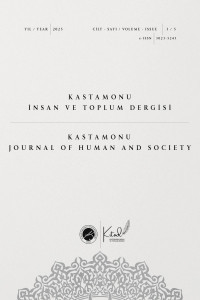
Volume: 3 Issue: 6 , 12/1/25

Year: 2025

Research Article

* To host scientific and current developments in the field of social sciences.

* To be an easily accessible and prestigious journal that allows academicians to publish.

* To provide readers with the opportunity to follow scientific developments through open access.

All sub-headings of all humanities and social sciences covers.

TEXT STYLE: Times New Roman
REFERENCES: APA 7 citation system should be used.
SIDE SPACES: 2 cm from the down edge and 2,5 cm from the other edges should be left.
ARTICLE LENGTH: Articles should be prepared between 2,000-10,000 words.
PARAGRAPH: It should be indented, 6 pt from the front and 6 nk from the end.
ORCID: Authors must upload their ORCID number to the system. If you do not have an ORCID number, you can get it from https://orcid.org/.

TEXT WRITING RULES: (Download the template from the system and use it)
* Article Title: First letter capitalized only (sentence order), 14 points, bold, centered, from front-rare 12 nk spacing, 1.15 line spacing.
* Author Names: The first letter of the name, the whole surname is capital, 10 pt, Italic, centered, from front-rare 6 nk, 1.15 line spacing.
* Abstract: 100-200 words, no indentation, 10 pt, from front-rare 6 nk, 1.15 line spacing.

* Extended Abstract: 750-1500 words account, no indentation, 10 pt, from front-rare 6 nk, 1.15 line spacing.

* Keywords: 3 to 8, in order from general to specific, only the first letter in compound words is capitalized.
* Main Text Headings: All caps, 12 pt, bold, from front-rare 6 nk, left aligned.
* Level I Text Title: Initial letters only capitalized, 12 pt, from front-rare 6 nk, bold, left aligned.
* II. Level Text: Sentence order, Italic, 12 pt bold, left aligned.
* Text: Indented sentence spelling, 12 pt, from front-rare 6 nk, 1.5 line spacing
* Result Title: All large, 12 pt bold left aligned.
* Result Text: Indented sentence writing order, 12 pt, from front-rare 6 nk, 1.5 line spacing.
* Bibliography Title: Entire capital, 12 pt, from front-rare 6 nk, bold left aligned.
* Sources: APA 7, in hanging order.

Kastamonu Journal of Human and Society (KJHS) Ethical Principles and Publication Policy Publication Ethics Statement:
It is considered that all parties involved in the publishing process (authors, editorial board and referees) have agreed on ethical behavior standards. Kastamonu Journal of Human and Society (KJHS) has developed international criteria for all parties in order to guarantee high ethical standards. This document has been created to make it easier for authors, editors, reviewers, and editorial boards to understand the principles they must follow in fulfilling their roles. While creating this document, the policies in the Committee on Publication Ethics (COPE) guide were followed.
Open Access Policy:
Kastamonu Journal of Human and Society (KJHS) is an open access journal. Anyone who wishes can publish in KJHS and benefit from the publications, provided that they comply with the scientific publication ethics rules. KJHS presents the articles it publishes free of charge with open access.
KJHS expects all parties to adhere to these criteria.

1. Behavioral Criteria That Author(s) Must Follow
Writers),

1) They do not claim copyright for the articles they send to KJHS.
2) They can send only original works to KJHS.
3) They prepare the bibliography list completely and specify the cited sources.
4) They have the right to withdraw their manuscripts before the article evaluation process begins. However, they must notify this in writing to the editor appointed for the article. The final decision for the article is taken by the KJHS Editorial Board. An article that has passed the peer-review stage cannot be withdrawn.
5) They declare and accept that there is no potential conflict of interest between them in their studies with more than one author.
6) They are obliged to send all kinds of documents and data requested by the editors or referees regarding the article.
7) They are responsible for informing the editor about any mistakes they discover later in their articles. In addition, they have to cooperate in line with the editor's demands.
8) They do not propose to change author responsibilities (add author, change author order, remove author, etc.) for articles whose evaluation process has begun.
9) that the work he sent to KJHS is not contrary to scientific research and publication ethics; plagiarism, forgery, distortion, republishing, slicing, unfair authorship and other ethical violations (not clearly stating the support people, institutions or organizations and their contributions to the research in the publications of supported research, not complying with ethical rules in research on humans and animals, It is deemed to have ensured that it does not include situations such as sharing the information contained in it with others before it is published, misusing the resources, places, facilities and devices provided or allocated for scientific research. Responsible for cases that have been determined otherwise.

2. Behavioral Criteria That Editors Must Follow
KJHS Editorial Board,
1) They make an effort to meet the information needs of readers and writers.
2) They support freedom of thought.
3) Organize and publish the "Blind Refereeing and Evaluation Process" in a clear, understandable and accountable manner; They prevent deviations that may occur in the defined processes.
4) They publish the "Author's Guide", which includes detailed topics that the authors will need, and ensure that the guide is up-to-date as needed.
5) Editor appointed for the article by the KJHS Editorial Board; It carries out the processes to improve the quality of the articles to be published in the journal. It conducts its business processes with respect to intellectual property rights and without compromising ethical standards.
6) Acts openly and transparently in matters that require correction and explanation.
7) It decides by considering the knowledge, skills and experience expectations that all readers, researchers and practitioners need.
8) Pays attention to the fact that the published articles provide scientific contribution to the reader, researcher, practitioner and are original.
9) Considers feedback from readers, researchers and practitioners; Provides descriptive and informative feedback.
10) After pre-checks (plagiarism scanning, suitability for spelling and bibliography, existence of a copyright form signed by the authors) of each article sent to KJHS, it sends the article to at least two referees for evaluation.
11) If one of the two referees expresses a negative opinion, he/she forwards the article to a third referee or gives the final decision.
12) It ensures that there is no conflict of interest between the authors and the referees in the selection and assignment of the referees.
13) Keeps the identity information of the referees confidential for blind refereeing.
14) Encourages referees to evaluate the work in an impartial, scientific and objective language.
15) Makes the final decision on whether an article can be published considering the original value of the article, its validity, clarity of expression, and its suitability with the aims and objectives of the journal.

3. Behavioral Criteria That Judges Must Follow

Referees,

1) They only make assessments in their areas of expertise.
2) They make an objective assessment. They do not allow nationality, gender, religious beliefs, political views and commercial concerns to influence the assessment.
3) They cannot have a conflict of interest with the authors or sponsors of the article.
4) They carry out the evaluation process in secrecy.
5) They can use the article they have evaluated only after the article is published and only for scientific purposes.
6) They express their views using polite and constructive language.
7) If they detect a situation contrary to scientific and ethical principles in the article they have reviewed, they inform the editor.

4. Behavioral Criteria That Publisher Must Follow
publisher,

1) It secures the work of editors, reviewers and authors.
2) It respects the property rights of the published articles and keeps the record in the archive.
3) KÜİTBFD keeps the internet access to the database open.
4) Before the article is published, it determines that the article does not contain plagiarism.

Everyone involved in the article publishing process agrees to abide by these rules. Editors, referees and authors involved in this process are expected to inform aytekindemircioglu@kastamonu.edu.tr if they detect an error or mistake.

Free of charge

Editör Kurulu

Philosophy of Education, Turkish Islamic Philosophy
Göknur Çetinkaya
Res. Assist. Dr. Göknur ÇETİNKAYA KASTAMONU ÜNİVERSİTESİ
Archaeology, Hellenistic Period Archeology, Greek and Roman Period Archeology, Old Anatolian History
Ayça Baydar
Asst. Prof. Dr. Ayça BAYDAR Kastamonu Üniversitesi
History of The Republic of Turkiye, Türkish Political Hİstory
Betül Karden Dal
Res. Assist. Betül Karden DAL Kastamonu Üniversitesi
Islamic Philosophy, Turkish Islamic Philosophy, Philosophy of Mind, Medieval Philosophy, History of Turkish Ideas
Beyhan Zabun
Prof. Dr. Beyhan ZABUN GAZİ ÜNİVERSİTESİ, GAZİ EĞİTİM FAKÜLTESİ
Sociology Education, Philosophy of Education, Educational Sociology
Beyza Toksoy
Asst. Prof. Dr. Beyza TOKSOY İstanbul Okan Üniversitesi
Entrepreneurship

Yayın ve Danışma Kurulu

Hajdi Xhixha
Asst. Prof. Dr. Hajdi XHİXHA University For Business and Technology
Russian Language, Literature and Culture, Political Science Methodology, International Security
Philosophy of Education, Turkish Islamic Philosophy
Mehmet Serhat Yılmaz
Prof. Dr. Mehmet Serhat YILMAZ KASTAMONU ÜNİVERSİTESİ
History of The Republic of Turkiye
Education, Education Management, Multicultural Education, Comparative and Cross-Cultural Education, Gender, Sexuality and Education, Education Policy
Ahmet Erkasap
Asst. Prof. Dr. Ahmet ERKASAP İSTANBUL GEDİK ÜNİVERSİTESİ
Human Resources Management, Strategy, Management and Organisational Behaviour, Organizasyon, Organisation and Management Theory, Organizational Culture, Organisational Behaviour
Ahmet Kılınç
Assoc. Prof. Dr. Ahmet KILINÇ Ankara Yıldırım Beyazıt Üniversitesi
Law and Legal Studies, Ottoman Society, Ottoman Institutions and Civilization (Other), Legal History, Islamic Law
Mustafa Eğilmez
Asst. Prof. Dr. Mustafa EĞİLMEZ KASTAMONU ÜNİVERSİTESİ, FEN-EDEBİYAT FAKÜLTESİ
Political and Civilization History of Islam, Medieval Folk Culture, Medieval Cities, History of Seljuk, History of Muslim Turkish Countries and Societies, Turkish and Islamic Intellectual History, Ottoman Institutions and Civilization, Islamic Intellectual History
Emilia Alaverdov
Prof. Dr. Emilia ALAVERDOV Georgian Technical University
European Union, European Studies, Globalisation, Conflict Resolution in International Relations
Seyhan Yilmaz
Prof. Seyhan YİLMAZ Kastamonu Üniversitesi
Arts and Cultural Policy, Art Education (Other), Digital and Electronic Media Art, Fine Arts, Ceramic Design, Plastic Arts (Other), Ceramic-Glass Design, Ceramics in Archeology
Ethics, Ontology, Turkish Islamic Philosophy, History of Turkish Ideas
Aylin Akinlar
Asst. Prof. Dr. Aylin AKİNLAR Bandırma Onyedi Eylül Üniversitesi
Multicultural, Intercultural and Cross-Cultural Studies, Curriculum Development in Education, Comparative and Cross-Cultural Education
History of The Republic of Turkiye, Late Modern History of Middle East
İsmet Üzen
Prof. İsmet ÜZEN çankırı karatekin üniversitesi
Turkish Political Life, History of The Republic of Turkiye
Beyhan Bayrak
Asst. Prof. Dr. Beyhan BAYRAK Düzce Üniversitesi
Values ​​education, Philosophical and Social Foundations of Education, Philosophy of Education, Educational Sociology, History of Ottoman Education
Olgun Değirmenci
Prof. Dr. Olgun DEĞİRMENCİ TOBB UNIVERSITY OF ECONOMICS AND TECHNOLOGY, FACULTY OF LAW
Computer Forensics, Criminal Law
Turkish Political Life, International Relations, Middle East Studies, Turkish Foreign Policy, Contemporary History of Middle East, History of The Republic of Turkiye, International History
Yavuz Unat
Prof. Dr. Yavuz UNAT KASTAMONU ÜNİVERSİTESİ
Philosophy of Science, History of Ideas, History of Turkish Ideas, History of Philosophy (Other)
Asena Kızılarslanoğlu
Asst. Prof. Dr. Asena KIZILARSLANOĞLU KASTAMONU ÜNİVERSİTESİ
Archaeology, Ceramics in Archeology, Greek and Roman Period Archeology
Ahmad Albattat
Asst. Prof. Dr. Ahmad ALBATTAT Asia Pacific University of Technology & Innovation (APU)
Crisis Communication, Disaster and Emergency Management, Hospitality Management, Tourism
İsmet Türkmen
Prof. Dr. İsmet TÜRKMEN TOKAT GAZİOSMANPAŞA ÜNİVERSİTESİ
Turkish Political Life, History of The Republic of Turkiye
Fahri Atasoy
Assoc. Prof. Dr. Fahri ATASOY GAZİ ÜNİVERSİTESİ, GAZİ EĞİTİM FAKÜLTESİ
Globalisation and Culture, Change, Underdevelopment and Modernisation Sociology, Sociology of Culture, Globalisation
History of The Republic of Turkiye
Nikoleta Zampaki
Dr. Nikoleta ZAMPAKİ National and Kapodistrian University of Athens
Ecocriticism, Comparative and Transnational Literature

Kastamonu Journal of Human and Society - KJHShttps://dergipark.org.tr/tr/download/journal-file/29447