Issue: 84 , 12/31/23

Year: 2023

Research Article

Review

The underlying motive of the journal is to create a platform for the works that produce scientific solutions for social, physical and nature-human relations and the understanding of its system.

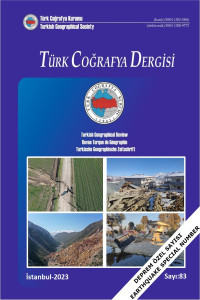
Turkish Geographical Review  is an open access, peer-reviewed, scholarly journal published two times a year in June and December. It has been published since 1943. 

Turkish Geographical Review is a scientific journal devoted to the publication of researches on physical and human geography of Turkey and the World, geographical information systems and remote sensing. Also, comprehensive reviews are accepted in the journal.

NEW SUBMISSIONS

Submission to this journal proceeds totally online and you will be guided stepwise through the creation and uploading of your files. The system automatically converts your files to a single PDF file, which is used in the peer-review process. As part of the Your Paper Your Way service, you may choose to submit your manuscript as a single file to be used in the refereeing process. This can be a PDF file or a Word document, in any format or layout that can be used by referees to evaluate your manuscript. It should contain high enough quality figures for refereeing. If you prefer to do so, you may still provide all or some of the source files at the initial submission. Please note that individual figure files larger than 10 MB must be uploaded separately.

References

There are no strict requirements on reference formatting at submission. References can be in any style or format as long as the style is consistent. Where applicable, author(s) name(s), journal title/book title, chapter title/article title, year of publication, volume number/book chapter and the pagination must be present. Use of DOI is highly encouraged. Note that missing data will be highlighted at proof stage for the author to correct.

Formatting requirements

There are no strict formatting requirements but all manuscripts must contain the essential elements needed to convey your manuscript, for example Abstract, Keywords, Introduction, Materials and Methods, Results, Conclusions, Artwork and Tables with Captions. If your article includes any Videos and/or other Supplementary material, this should be included in your initial submission for peer review purposes. Divide the article into clearly defined sections.

Figures and tables embedded in text

Please ensure the figures and the tables included in the single file are placed next to the relevant text in the manuscript, rather than at the bottom or the top of the file.

REVISED SUBMISSIONS

Use of word processing software Regardless of the file format of the original submission, at revision you must provide us with an editable file of the entire article. Keep the layout of the text as simple as possible. Most formatting codes will be removed and replaced on processing the article.  To avoid unnecessary errors you are strongly advised to use the 'spell-check' and 'grammar-check' functions of your word processor.

Article structure

Subdivision - numbered sections Divide your article into clearly defined and numbered sections. Subsections should be numbered 1.1 (then 1.1.1, 1.1.2, ...), 1.2, etc. (the abstract is not included in section numbering). Use this numbering also for internal cross-referencing: do not just refer to 'the text'. Any subsection may be given a brief heading. Each heading should appear on its own separate line.

Please ensure the text of your paper is double-spaced and has consecutive line numbering this is an essential peer review requirement.

Introduction

State the objectives of the work and provide an adequate background, avoiding a detailed literature survey or a summary of the results.

Regional setting:

For papers that focus on an area, provide a brief synopsis of the physical and geological characteristics of the area, sufficient to give the new work context, but again avoid a detailed literature survey.

Material and methods

Provide sufficient detail to allow the work to be reproduced. Methods already published should be indicated by a reference: only relevant modifications should be described.

Results

Results should be clear and concise. This should highlight the key results (and not repeat material already in figures or tables) and summarise the direct implications of these results.

Discussion

This should explore the significance of the results of the work, not repeat them. A combined Results and Discussion section is often appropriate. Avoid extensive citations and discussion of published literature.It may include limited speculation, that will not appear in the conclusions.

Conclusions

The main conclusions of the study may be presented in a short Conclusions section, which may stand alone or form a subsection of a Discussion or Results and Discussion section.

Acknowledgements

Collate acknowledgements in a separate section at the end of the article before the references and do not, therefore, include them on the title page, as a footnote to the title or otherwise. List here those individuals who provided help during the research (e.g., providing language help, writing assistance or proof reading the article, etc.). Place acknowledgements, including information on grants received, before the references, in a separate section.

Appendices

If there is more than one appendix, they should be identified as A, B, etc. Formulae and equations in appendices should be given separate numbering: Eq. (A.1), Eq. (A.2), etc.; in a subsequent appendix, Eq. (B.1) and so on. Similarly for tables and figures: Table A.1; Fig. A.1, etc.

Essential title page information

• Title. Concise and informative. Titles are often used in information-retrieval systems. Avoid abbreviations and formulae where possible. • Author names and affiliations. Please clearly indicate the given name(s) and family name(s) of each author and check that all names are accurately spelled. Present the authors' affiliation addresses (where the actual work was done) below the names. Indicate all affiliations with a lowercase superscript letter immediately after the author's name and in front of the appropriate address. Provide the full postal address of each affiliation, including the country name and, if available, the e-mail address of each author.

• Corresponding author. Clearly indicate who will handle correspondence at all stages of refereeing and publication, also post-publication. Ensure that the e-mail address is given and that contact details are kept up to date by the corresponding author.

• Present/permanent address. If an author has moved since the work described in the article was done, or was visiting at the time, a 'Present address' (or 'Permanent address') may be indicated as a footnote to that author's name. The address at which the author actually did the work must be retained as the main, affiliation address. Superscript Arabic numerals are used for such footnotes. 
All submissions must be original, unpublished (including as full text in conference proceedings), and not under the review of any other publication synchronously. Each manuscript is reviewed by one of the editors and at least two referees under double-blind peer review process. Plagiarism, duplication, fraud authorship/denied authorship, research/data fabrication, salami slicing/salami publication, breaching of copyrights, prevailing conflict of interest are unnethical behaviors.

All manuscripts not in accordance with the accepted ethical standards will be removed from the publication. This also contains any possible malpractice discovered after the publication. In accordance with the code of conduct we will report any cases of suspected plagiarism or duplicate publishing.

License(s) permitted by the journal

©️2021 by the authors; license TGR, İstanbul, Turkey. This article is an open-access article distributed under the terms and conditions of the Attribution-NonCommercial 4.0 International (CC BY-NC 4.0) License (https://creativecommons.org/licenses/by-nc/4.0/). There is no publication charge or Article Processing Charge (APC) in Turkish Geographical Review.

Editor-in-Chief

Cihan Bayrakdar
Prof. Dr. Cihan BAYRAKDAR ISTANBUL UNIVERSITY, FACULTY OF LETTERS, DEPARTMENT OF GEOGRAPHY Web

Dr. Cihan Bayrakdar received his Bachelor's degree from Istanbul University, Department of Geography in 2002, his Master's degree from Istanbul University, Physical Geography in 2006 on ‘Applied Geomorphology’ and his PhD degree from Istanbul University, Physical Geography in 2012 on ‘Glacial Geomorphology’. Bayrakdar also completed his post-doctorate on ‘Cosmogenic Dating’ at the Geological Institute of Bern University in Switzerland in 2014. Dr Bayrakdar became a Research Assistant at Istanbul University, Faculty of Letters, Department of Geography, Department of Physical Geography in 2005, Assistant Professor in 2014, Associate Professor of Physical Geography in 2019 and has been working as a Professor at the same university since 2024. He generally works on Glacial Geomorphology, Applied Geomorphology, Tectonic Geomorphology, Remote Sensing and Geographic Information Systems. Dr Bayrakdar is the Secretary General of the Geomorphology Association and Editor-in-Chief of the Turkish Journal of Geography.

Translated with DeepL.com (free version)

Geomorphology and Earth Surface Processes, Physical Geography

Co-Editor

Mehmet Şeremet has a PhD from the UK’s Plymouth University on GIS education and employability in the UK and Turkey. His current post is that of Reader in Human Geography at Van Yuzuncu Yil University in Turkey. He leads sustainable tourism-oriented projects in different parts of Turkey, including the Black Sea Region, and the Aegean and West Mediterranean Regions. He is also the co-editor of the Turkish Geographical Review and Geographies, Planning & Tourism Studies journals. His research includes critical subjects in both human geography and tourism studies, such as critical geopolitics, border learning experience, gender and sustainability, feminist geography, and critical GIS.

Geography Education, Cultural Geography, Sustainable Tourism

Publication Coordinator

Tolga Görüm
Prof. Dr. Tolga GÖRÜM İSTANBUL TEKNİK ÜNİVERSİTESİ Web

Tolga Görüm is a geomorphologist interested in elucidating the mass wasting processes in different tectonic and geomorphic environments, their role in sculpting the landscapes, and mountain range evolution as a limiting factor for topographic development. In this respect, he is working on linking long- and short-term variability of erosion rates and landslide episodes at regional and local scales. He is using modern tools such as LIDAR and UAV in addition to field-based observations and measurements, geospatial technologies, geomorphic mapping and morphometric analysis, and radiometric dating techniques (e.g., Cosmogenic, OSL, and 14C) for erosion-process deciphering. In addition, considering that his secondary field of expertise is in landslide science, he seeks ways to apply soft computing techniques (e.g., Fuzzy Logic, Machine Learning algorithms) to improve the landslide susceptibility and hazard models for a safer environment.

Geographic Information Systems, Natural Hazards, Geomorphology and Earth Surface Processes

Editorial Board

Default avatar
Prof. Dr. Barbaros GÖNENÇGİL İSTANBUL ÜNİVERSİTESİ
Ecology, Biogeography, Watershed Management, Hydrography, Geomorphology and Earth Surface Processes, Physical Geography, Climatology
İbrahim Sirkeci
Prof. Dr. İbrahim SİRKECİ International Business School, Manchester Web
Professor Ibrahim Sirkeci, (PhD, Sheffield, PGCE, UCL, BA, Bilkent) is an academic entrepreneur with three decades of higher education experience covering all domains of teaching, research and leadership in universities in the UK, Europe and Turkey. Professor Sirkeci most recently served as the head of Enterprise Subject Group at the University of Salford Business School in Manchester. For over two decades, he has worked at various universities including the University of Bristol, University of Hertfordshire, Coventry University, Edinburgh Napier University and Regent’s University London where he served as Head of Marketing department and director of several research centres and earned the full professorship when he was just 37 on his extraordinarily prolific academic and research record. He is also the founder of now well-established independent publishing house, Transnational Press London. In addition, he has established international academic conferences, including the prestigious Migration Conferences taking place in leading universities and cities annually. Professor Sirkeci is also serving in the boards of two not for profit organisations, Ming Ai Institute and Association of British Turkish Professionals.

Contact Prof Sirkeci at sirkeci@theibs.uk
Migration, Migration Sociology, Sociology (Other)
İhsan Çiçek
Prof. Dr. İhsan ÇİÇEK Ankara Üniversitesi Web
Physical Geography and Environmental Geology, Natural Hazards, Geomorphology and Earth Surface Processes, Climatology, Climate Change Processes
T. Ahmet Ertek
Assoc. Prof. Dr. T. Ahmet ERTEK İSTANBUL ÜNİVERSİTESİ
Geomorphology and Earth Surface Processes, Quaternary Environments, Physical Geography, Earth System Sciences
Default avatar
Prof. Dr. Naki AKÇAR University of Bern Web
General Geology, Glaciology, Quaternary Environments
İhsan Bulut
Prof. Dr. İhsan BULUT Akdeniz Üniversitesi
Human Geography, Cultural Geography, Turkish Human Geography, Turkish Economic Geography, Habitation Geography, Migration
Default avatar
Prof. Dr. Maria PARADİSO University of Naples Federico II
Population Geography, Human Geography (Other)
Default avatar
Prof. Dr. Michael MEADOWS Nanjing University

Michael Meadows, Immediate Past President of the International Geographical Union, is currently Professor in the School of Geography and Ocean Sciences at Nanjing University, China, but retains a research position in the Department of Environmental and Geographical Science at the University of Cape Town, where he was Head of Department from 2001-2017. Meadows has authored or co-authored more than 300 peer-reviewed research articles, including in Nature Communications, Nature Geoscience, Science Advances, PNAS, Geology, and Science Bulletin, He recently co-edited two major review volumes: Research Directions, Challenges and Achievements of Modern Geography (Springer, 2023) and Geography of the Anthropocene (Istanbul University Press, 2024). Meadows’ research interests lie broadly in the field of physical geography and more specifically concern environmental change and the geomorphological and ecological impacts of recent natural and human-induced changes. Meadows is an elected Fellow of the Royal Geographical Society, the Society of South African Geographers, the Royal Society of South Africa, the African Academy of Science, Academia Europaea and of the University of Cape Town. He is also a Fellow of the Geographical Society of China and of the International Science Council. He is recipient of the 2024 Royal Society of South Africa’s Marloth Medal for “highly distinguished, multidisciplinary contributions to the furtherance of science”.

Biogeography, Geomorphology and Earth Surface Processes, Physical Geography

Foreign Language Editor

Mehmet Şeremet
Assoc. Prof. Dr. Mehmet ŞEREMET Van Yüzüncü Yıl University Web

Mehmet Şeremet has a PhD from the UK’s Plymouth University on GIS education and employability in the UK and Turkey. His current post is that of Reader in Human Geography at Van Yuzuncu Yil University in Turkey. He leads sustainable tourism-oriented projects in different parts of Turkey, including the Black Sea Region, and the Aegean and West Mediterranean Regions. He is also the co-editor of the Turkish Geographical Review and Geographies, Planning & Tourism Studies journals. His research includes critical subjects in both human geography and tourism studies, such as critical geopolitics, border learning experience, gender and sustainability, feminist geography, and critical GIS.

Geography Education, Cultural Geography, Sustainable Tourism

The Print Editor

Mahsum Bozdoğan
Doctoral Mahsum BOZDOĞAN İstanbul Üniversitesi
Geographic Information Systems, Geomorphology and Earth Surface Processes, Physical Geography
Default avatar
Res. Assist. Onur HALİS İSTANBUL ÜNİVERSİTESİ
Geographic Information Systems, Geomorphology and Earth Surface Processes
Default avatar
Doctoral Fatih DARICI İSTANBUL ÜNİVERSİTESİ
Geographic Information Systems, Geomorphology and Earth Surface Processes, Physical Geography

Publisher: Türk Coğrafya Kurumu / Turkish Geographical Society
