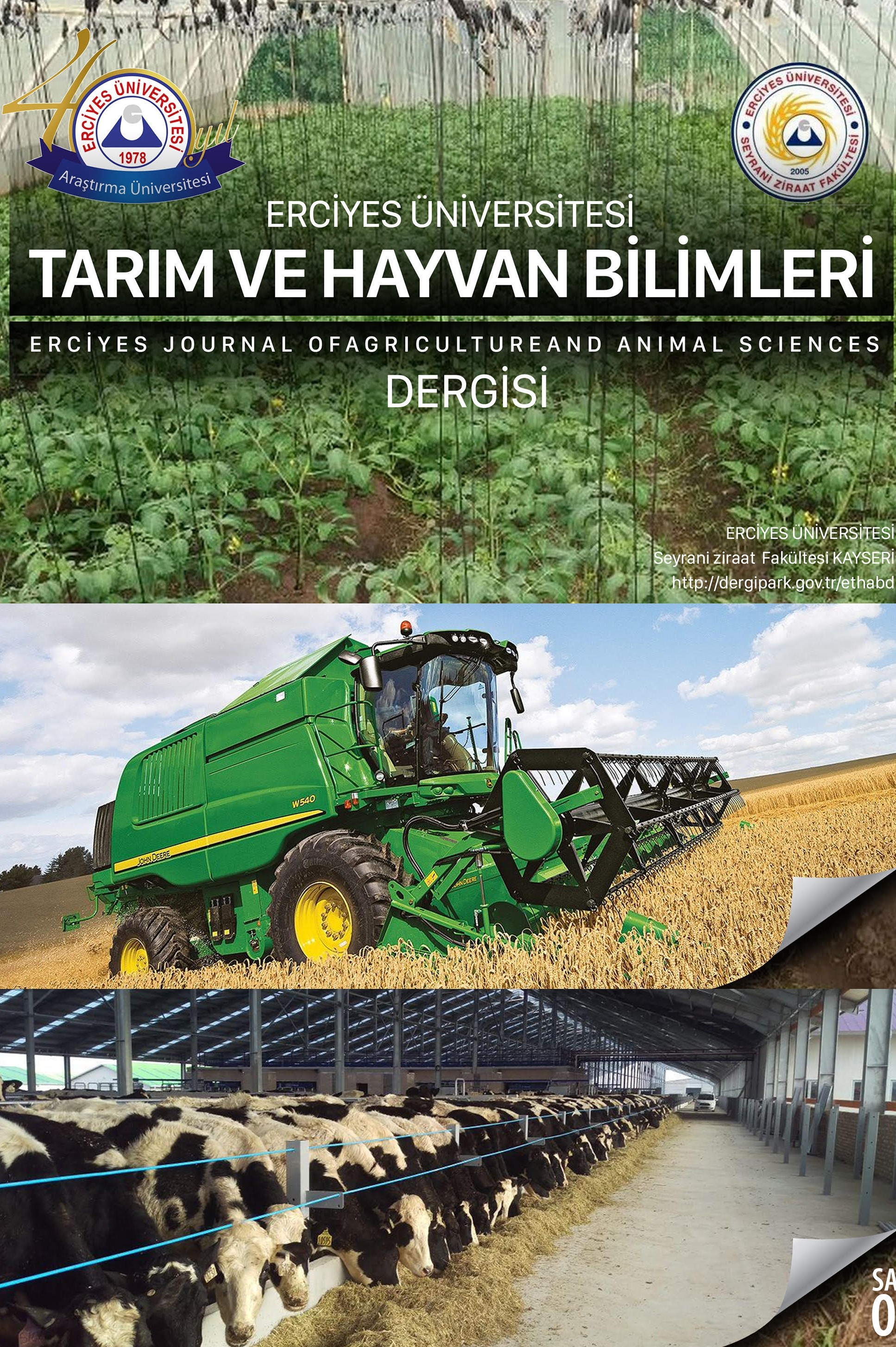

Journal of Erciyes Agriculture and Animal Sciences is the scientific publication organ of Erciyes University Faculty of Agriculture; It is an international scientific journal that publishes original studies in agricultural sciences (horticulture, plant protection, biosystems engineering, landscape architecture, agricultural economics, agricultural biotechnology, field crops, soil science and plant nutrition, aquaculture engineering, food and dairy technology, veterinary medicine, zootechnics, and many other basic and applied research), following a peer-reviewed review. The journal is published semiannually, in the sixth and twelfth months of the year, with two issues completing a volume. However, special issues may also be published in some cases.
Journal of Erciyes Agriculture and Animal Sciences is a international, periodical and peer-reviewed scientific journal that publishes original articles produced in the fields of agriculture and animal husbandry. Turkish and English articles are accepted and 2 issues are published online per year.
WRITING RULES
Article Language: The manuscript language can be Turkish (English abstract is mandatory) or English (English articles will be given priority). For articles, tables, graphics and bibliography, the font must be Times New Roman and 12 pt.
Title: It should be short and descriptive, 12 point and bold in Times New Roman font, the first letter of the words should be capitalized, centered and should describe the work as soon as possible. Name and institution information of the authors should be given under the title and the responsible author should be indicated and e-mail address should be given. English title should be written exactly before the Abstract and Turkish Abstracts and Keywords should be written exactly in Turkish, Times New Roman font should be 12 pt, bold and centered.
Abstract and Key Words: Each of the abstracts in Turkish and English should not exceed 300 words. Türkçe Abstract ”and“ Abstract sırasıyla words should be used in Turkish and English abstracts respectively.
At least 4, at most 6 keywords should be written under 1 line of the Turkish and English abstracts, with the first letter of the keyword in uppercase and lowercase letters, if possible, not used in the title, to best describe the study and with a comma (,) between them.
1. INTRODUCTION
In this chapter; study subject, justification, previous studies directly related to the subject and the purpose of the study are given.
2. MATERIALS AND METHODS
The material and method used should be given under the same title. If the subtitle is to be given, it should be numbered with the section number (such as 2.1) and italicized. New or modified methods should be described in such a way as to allow employees to repeat the research on the same subject.
3. RESEARCH FINDINGS AND DISCUSSION
Obtained findings should be given and if necessary, the findings should be supported by tables, figures and graphics.
Obtained findings should be given either as chart or graph in order to avoid repetition. The factors that are found to be statistically significant should be interpreted with the comparison method appropriate to the applied statistical analysis technique and the relevant statistics should be lettered. In cases where the statistical analysis method is not selected correctly and / or the analysis is not performed properly, the editorial board may exclude the article from the evaluation. Findings should be discussed but unnecessary repetitions should be avoided. The similarities and differences of the findings with other studies should be given and the reasons should be explained.
4. RESULTS AND RECOMMENDATIONS
The results obtained should be given concisely with their contribution to science and practice. The statements given in the Introduction and Research Results and Discussion section should not be repeated in this section in the same way.
THANK
If necessary, it should be as short as possible and the contribution should be expressed.
RESOURCES
References to the sources used in the work should be made according to the method of “(Author's surname year) içinde.
Sample:
(Doymaz, 2003), (Basunia and Abe 2001). If the author is cited, only the year of publication should be in parentheses. Example: According to Doymaz (2003) or Basunia and Abe (2001). For three or more authors, citation in the article should be used by “et al. Ark. Example: (Lawrence et al., 2001) or Lawrence et al. et al., (2001). If the same author has more than 1 publication in the same year, lower case letters should be given after the year. Example: (Akpinar et al., 2003a). If more than one publication of the same author is to be cited, it must be distinguished after the year with a semicolon (;). Example: (Akpınar, 2007; 2009; 2013). If multiple citations are made, a semicolon (;) must be used between citations. Example: (Perl et al., 1987; Bailly et al., 1996; Copeland and McDonald, 2001; Goel and Sheoran, 2003). If information is intended to be taken from a particular page or pages of the source (Hardeman and Jochemsen, 2012, pp. 657-674; Naess, 1991, p. 34). References should not be shown as Anonymous or Anonymous.
All references cited in the references section are given in alphabetical order (according to the surnames of the authors) and in the original language. In the notification of works with two or more authors, son and or and should be used before the last author. Example: Lawrence, K. C., Funk, D. B., and Windham, W. R., 2001. No dot (.) Sign should be placed at the end of the source. Journal names should be written with full name and italics without abbreviation. No reference can be made to the studies published in Turkish or foreign languages in the congress books. The responsibility for the incorrect citations and references in the article belongs to the author .There should not be a period . At the end of each resource in the References section.
Journal:
Doymaz. I., 2003. Drying kinetics of white mulberry. Journal of Food Engineering 61(3): 341-346.
Basunia, M. A., and Abe, T., 2001. Thin-layer solar drying characteristics of rough rice under natural convection. Journal of Food Engineering 47(4): 295-301.
Lawrence, K. C., Funk, D. B., and Windham, W. R., 2001. Dielectric moisture sensor for cereal grains and soybeans. Transactions of the ASAE 44(6): 1691-1696.
Akpinar, E., Midilli, A., and Bicer, Y., 2003a. Single layer drying behaviour of potato slices in a convective cyclone dryer and mathematical modelling. Energy Conversion and Management 44(10): 1689-1705.
Book:
Yıldırım, O., 1996. Bahçe Bitkileri Sulama Tekniği. Ankara Üniversitesi Ziraat Fakültesi Yayınları: 1438, Ders Kitabı: 420, Ankara
Mohsenin, N. N., 1970. Physical Properties of Plant and Animal Materials. Gordon and Breach Science Publishers, New York
Book Chapter:
Fıratlı, Ç., 1993. Arı yetiştirme. (Ed: M Ertuğrul), Hayvan Yetiştirme, Baran Ofset, Ankara, s. 30-34
Rizvi, S. S. H., 1986. Thermodynamic properties of foods in dehydration. In: M A Rao & S S H Rizvi (Eds), Engineering Properties of Foods, Marcel Dekker, New York, pp. 190-193
Author unspecified Agency Publications:
TUİK, 2012. Tarım İstatistikleri Özeti. Türkiye İstatistik Kurumu, Yayın No: 3877, Ankara
ASAE, 2002. Standards S352.2, 2002, Moisture measurement-unground grain and seeds. ASAE, St. Joseph, MI
Information received from the Internet:
FAO, 2013. Classifications and standards. http://www.fao.org/economic/ess/ess-standards/en/ (Erişim tarihi:10.02.2013)
Thesis:
Koyuncu, T., 1992. Tarım arabalarında kullanılan çarpma etkili frenlerin araştırılması. Yüksek lisans tezi, Ankara Üniversitesi Fen Bilimleri Enstitüsü (Basılmamış), Ankara.
Berbert, P. A., 1995. On-line density-independent moisture content measurement of hard winter wheat using the capacitance method. PhD Thesis, Crandfield University (Unpublished), UK.
Full Text Congress / Symposium Book:
Yağcıoğlu, A., Değirmencioğlu, A., and Cağatay, F., 1999. Drying characteristics of laurel leaves under different drying conditions. In: Proceedings of the 7th International Congress on Agricultural Mechanization and Energy, 26–27 May, Adana, Turkey, pp. 565–569
Kara, Z., ve Beyoğlu, N., 1995. Konya ili Beyşehir yöresinde yetiştirilen üzüm çeşitlerinin göz verimliliklerinin belirlenmesi üzerine bir araştırma. Türkiye II. Ulusal Bahçe Bitkileri Kongresi. Bildiriler (II): 3-6 Ekim, Adana, s. 524-528
Copyright Transfer Agreement
1. All publishing rights belong to Erciyes Journal of Agriculture and Animal Sciences,
2. It complies with the writing and publication rules specified by the journal,
3. The article is original and has not been previously published in Turkish or a foreign language at home or abroad, or is not in the process of being evaluated for publication,
4. If the scientific and ethical responsibility belongs to us, other authors cannot be reached; I accept and declare that all authors are aware of the study and that I take the responsibilities of other authors as the first author of the article.
Authors in all articles submitted to the Erciyes Journal of Agriculture and Animal Sciences are required to sign the "Copyright Transfer Agreement", the content of which is stated above. This contract text should be downloaded on the article submission page and signed by all authors, scanned in PDF format and uploaded to the system.
Publication Fee
It does not charge any processing and publication fees for the articles sent to the Erciyes Journal of Agriculture and Animal Sciences.
Ebubekir Yüksel 1986 yılında Ankara’da doğdu. 2008 yılında Ankara Üniversitesi Ziraat Fakültesi Bitki Koruma Bölümünü bitirdi. 2012-2014 yılları arasında Uluslararası Mısır ve Buğday Geliştirme Merkezi (CIMMYT)’nde çalıştıktan sonra 2014 yılında Erciyes Üniversitesi Ziraat Fakültesi Bitki Koruma Bölümünde araştırma görevlisi olarak kariyerine devam etti. 2023 yılında Erciyes Üniversitesi Ziraat Fakültesi Bitki Koruma Bölümüne öğretim üyesi olarak atandı. Bitki Koruma, Nematoloji, Entomoloji, Böcek Patolojisi ve Tarımsal Zararlılarla Biyolojik Mücadele başlıca çalışma alanlarını oluşturmaktadır.
Ben, Mersin Üniversitesi’nde Bitki Biyoteknolojisi alanında Doçent olarak görev yapmaktayım. Doktora derecemi 2019 yılında Bolu Abant İzzet Baysal Üniversitesi, Ziraat ve Doğa Bilimleri Fakültesi, Tarla Bitkileri Bölümü’nden, “Türk Fasulye Genotiplerinde Çeşitli Tarımsal Özellikler için Genom Düzeyinde İlişkilendirme Çalışmaları (GWAS) ile Genomik Bölgelerin Belirlenmesi” başlıklı tez çalışmam ile aldım. 2020 yılında Sivas Bilim ve Teknoloji Üniversitesi’nde Dr. Öğretim Üyesi olarak göreve başladım ve 27.01.2023 tarihinde Doçent unvanını aldım. 2025 yılında ise Mersin Üniversitesi’ne katıldım.
ERA-NET SusCrop, COST Action, TÜBİTAK 1001, 1003 ve 1007 programları kapsamında çeşitli projelerde görev aldım. Ayrıca, üniversite destekli BAP projelerinde de aktif olarak yer almaktayım. Bitki ıslahı ve bitki genomikleri alanlarında kapsamlı bilgi ve beceriye sahibim. Özellikle yeni nesil dizileme teknolojileri, DNA moleküler markörleri ile genotip karakterizasyonu, tarımsal öneme sahip özelliklere ilişkin genomik bölgelerin belirlenmesi, moleküler markör geliştirilmesi ve validasyonu ile markör destekli seleksiyon uygulamalarında, özellikle tahıllar ve baklagillerde uzmanlık sahibiyim. Hâlihazırda üç doktora ve bir yüksek lisans öğrencisine danışmanlık yapmaktayım. Bugüne kadar üç yüksek lisans öğrencisi mezun ettim ve bir doktora öğrencisine ortak danışmanlık yaptım.
SCI/SCIE kapsamındaki dergilerde 80’in üzerinde makalem, 10’dan fazla kitap bölümüm ve Google Scholar verilerine göre 3500’ün üzerinde atfım bulunmaktadır. Ayrıca Springer yayınevinden dört kitap editörlüğü yaptım. BMC Plant Biology, BMC Genomic Data, BMC Research Notes, Molecular Biology Reports, Genetic Resources and Crop Evolution ve Pakistan Journal of Botany dergilerinde editörler kurulu üyesi olarak görev yapmaktayım. Benzer şekilde, Plants-Basel, Agriculture-MDPI ve Molecular Biology Reports dergilerinde özel sayı editörlüğü yaptım. 2023 ve 2024 yıllarında üst üste iki yıl boyunca Stanford Üniversitesi (California, ABD) ve Elsevier tarafından yayımlanan listede Dünyanın En İyi %2 Bilim İnsanı arasında yer aldım
Ankara üniversitesi ziraat fakültesi bitki koruma bölümünde insektisit direnci ve direncin moleküler mekanizmaları üzerinde çalışmalar yürütmektedir.
1981 yılında Kayseri’de doğdu. 2003 yılında Kahramanmaraş Sütçü İmam Üniversitesi, Ziraat Fakültesini başarıyla tamamladı. Yüksek lisans ve doktora eğitimini aynı üniversitede tamamladı. 2003 yılında Kahramanmaraş Sütçü İmam Üniversitesi Ziraat Fakültesi’nde akademik çalışma hayatına araştırma görevlisi olarak başladı. 2006 yılında T.C. Tarım ve Orman Bakanlığına Mühendis olarak atandı. Bakanlıkta av yaban hayatı koordinatörü olarak görev aldı. 2014 yılında yardımcı doçent olarak Kahramanmaraş Sütçü İmam Üniversitesi, Göksun Meslek Yüksekokulu’nda akademik çalışma hayatına devam etti. 2018 yılında aynı üniversitede doçent oldu. Ulusal ve uluslararası dergilerde birçok makalesi yayımlandı. Birçok toplantı ve kongrede konuşmacı olarak yer aldı. Evli ve 1 çocuk babasıdır.