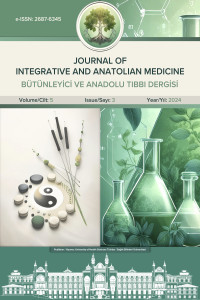
Journal of Integrative and Anatolian Medicine is an international, peer-reviewed, open access journal, scientifically supported by the University of Health Sciences, Türkiye, Traditional and Complementary Medicine Application and Research Centre (GETAT UAM).
The journal targets researchers, educators, and healthcare practitioners, including those interested in traditional, complementary, and integrative medicine, who seek impartial and critical knowledge in these fields. It aims to build a scientifically grounded bridge between the wisdom of traditional medicine and the evidence-based approach of modern medicine. In line with this aim, Journal of Integrative and Anatolian Medicine provides an innovative, interdisciplinary, and international academic platform.
Before submitting your article, please carefully read the author guidelines, ethical principles, and publication policy.
Manuscript Submission and Review Process
Language of Writing: The language of writing should be Turkish and/or English, and the text of the article should be written in an understandable, simple, and fluent style with technical expressions in the relevant field. Unnecessary and well-known information, and unnecessary sources should be avoided; previously published data, formulas, and results should be cited and quoted properly.
File Format: It is preferred that articles should be written using MS Word program (with .doc or .docx extension), not exceeding fifteen (15) pages for research articles and twenty (20) pages for review articles.
Title Page
Click to download the appropriate title page template for your article language:
Title Page Template (EN)
Başlık Sayfası Şablonu (TR)
Journal of Integrative and Anatolian Medicine employs a double-blind peer review system. Through this system, the identities of both authors and reviewers remain mutually anonymous; to ensure impartiality and fairness throughout the evaluation process. Accordingly, at the time of submission, the title page containing all required information must be uploaded separately from the main manuscript. The main manuscript must not include the author's name, institutional affiliation, or any other identifiable information. Strict adherence to this requirement is essential for the double-blind peer review process to be valid.
The title page must include the following information:
- Consent to participate (if applicable): All research involving human participants requires that freely given, informed consent is obtained from each participant prior to inclusion in the study. A clear statement confirming that informed consent has been obtained must be included in the "Materials and methods" section of the article.
- Consent to publish (if applicable): For case reports or any article that includes identifiable patient data, photographs, or other materials, authors must obtain written informed consent for publication from the patients or their legal guardians. The consent form must clearly indicate that the patient understands that their personal data and/or images may be published in a scientific journal and made publicly accessible online. A clear statement confirming that written informed consent has been obtained must be included in the "Materials and methods" section of the article. The consent form must be available to editors upon request.
International author(s) are not required to submit Turkish title, abstract, and keywords; the editorial board will provide support in this regard.
Main Manuscript
Click to download the appropriate main manuscript template for your article language:
Main Manuscript Template (EN)
Ana Makale Şablonu (TR)
Title: Each article should have a title in both Turkish and English. They should be short, clear and adequately reflect the content of the article, written with first letter capitalized.
Abstract and Keywords: The abstract should reflect the purpose, scope and results of the study. It should be at least 100 and at most 250 words, and keywords of at least 3 and at most 6 words should be written below the abstract. It is recommended that Turkish keywords be provided according to "Türkiye Bilim Terimleri (TBT)" and English keywords according to "Medical Subject Headings (MeSH)".
Main Headings: They should be written with first letter capitalized; left justified and bold. Without numbering; make your research article structured as Introduction, Materials and methods, Results, Discussion or Results and discussion, and Conclusion. In review articles, the main headings other than Introduction and Conclusion sections are left to the discretion of the author(s).
Figures, tables, maps and photographs should not extend beyond the text area and, if necessary, may be placed on separate pages. All figures, illustrations, and photographs must be submitted in high resolution to ensure publication quality. Figures and tables should be numbered and titled in Turkish and/or English according to their content. Numbers and titles should be centered, placed below figures and above tables, and written in sentence case (with only the first letter of the sentence capitalized). Figure and table captions must be numbered consecutively (e.g., Figure 1., Figure 2., …; Table 1., Table 2., …).
References: The APA 7th edition citation style is used for in-text citations and references list. Authors are responsible for ensuring that all references are complete and accurate. The reference list should be ordered alphabetically. If a DOI (Digital Object Identifier) is available, it must be included in the reference list entry and presented as an active hyperlink in the format. Click here for more information about APA style citation.
Reference Format Examples for APA 7th Edition:
Note on number of authors
***
Article
> Ali, S. I., Gopalakrishnan, B., & Venkatesalu, V. (2017). Pharmacognosy, Phytochemistry and Pharmacological Properties of Achillea millefolium L.: A Review. Phytotherapy Research, 31(8), 1140–1161. https://doi.org/10.1002/ptr.5840
Book
> Panini, S. R. (2021). Medical biochemistry: An essential textbook (2nd ed.). Thieme.
Book chapter
> Zeleke, W. A., Hughes, T. L., & Drozda, N. (2020). Home–school collaboration to promote mind–body health. In C. Maykel & M. A. Bray (Eds.), Promoting mind–body health in schools: Interventions for mental health professionals (pp. 11–26). American Psychological Association. https://doi.org/10.1037/0000157-002
Conference proceedings
> Cismas, S. C. (2010). Educating academic writing skills in engineering. In P. Dondon & O. Martin (Eds.), Latest trends on engineering education (pp. 225-247). WSEAS Press.
Thesis/dissertation
> Kabir, J. M. (2016). Factors influencing customer satisfaction at a fast food hamburger chain: The relationship between customer satisfaction and customer loyalty (Publication No. 10169573) [Doctoral dissertation, Wilmington University]. ProQuest Dissertations & Theses Global.
Click here for more information about APA style citation.
In-Text Citation for APA 7th Edition:
Plagiarism Policy
Journal of Integrative and Anatolian Medicine is an international, peer-reviewed, open access scientific journal, published online three times a year (in April, August, and December) by the University of Health Sciences, Türkiye. Before submitting your article to the journal, please carefully read the author guidelines, ethical principles, and publication policy.
Ethical Principles
Publication Ethics and Malpractice Statement
Journal of Integrative and Anatolian Medicine strictly adheres to internationally recognized research and publication ethics standards established by the Committee on Publication Ethics (COPE), International Committee of Medical Journal Editors (ICMJE), World Association of Medical Editors (WAME), and Council of Science Editors (CSE). All parties — authors, reviewers, and editors — are required to comply with principles of research and publication ethics, including objectivity, transparency, accuracy, reliability, confidentiality, and disclosure of potential conflicts of interest.
Authors' Responsibilities
Reviewers' Responsibilities
Editors' Responsibilities
The following situations are considered serious ethical violations in academic publishing:
Detected ethical violations are handled in accordance with the COPE guidelines and above mentioned internationally recognized standards.
Conflict of Interest Policy
Human and Animal Rights Policy
All studies involving human participants must comply with the Declaration of Helsinki. Research involving animals must adhere to the 3Rs (Replacement, Reduction and Refinement) and follow the international guidelines above mentioned. Prior to the commencement of any study, appropriate ethics committee approvals and necessary consents must be obtained. Authors are responsible for declaring that ethical approval has been secured and that the research was conducted in line with both national and international standards and guidelines. Editors and reviewers are responsible for ensuring that submitted manuscripts meet ethical standards and may request additional documentation or clarification from authors when necessary.
Ethics committee approval (if applicable): Ethics committee approval for this study was obtained from the [Name of Ethics Committee] (Date: …, No: …). Ethics committee approval must also be stated in the "Materials and methods" section of the article and uploaded to the DergiPark system.
Publication Policy
Editorial Procedure and Peer Review
All manuscripts submitted to Journal of Integrative and Anatolian Medicine undergo rigorous evaluation in accordance with the Committee on Publication Ethics (COPE), International Committee of Medical Journal Editors (ICMJE), World Association of Medical Editors (WAME), and Council of Science Editors (CSE) guidelines.
The typical manuscript review period is 4–6 weeks, subject to variation depending on reviewers' response times.
Open Access, Licensing and Copyright Policy
Journal of Integrative and Anatolian Medicine is an open access journal that provides free and immediate worldwide access to all published content. In line with the Budapest Open Access Initiative (BOAI), the journal supports the global sharing of scientific knowledge. All content is licensed under the Creative Commons Attribution-NonCommercial 4.0 International (CC BY-NC 4.0). Everyone is free to reuse published materials for non-commercial purposes; however, proper and complete attribution to the original article is required for all uses.
The author(s) retain copyright of the manuscript under the Creative Commons Attribution-NonCommercial 4.0 International (CC BY-NC 4.0) license. If the manuscript is accepted for publication, the author(s) transfer the commercial rights to the Journal of Integrative and Anatolian Medicine, granting the journal the right to publish, reproduce, distribute, archive, and commercially exploit the manuscript in all forms and media. Each author of the manuscript is required to carefully read and sign the Copyright Agreement Form (click to download). The completed form, bearing the original signatures, must be scanned and uploaded to the DergiPark system at the time of manuscript submission.
Archiving Policy
The journal permits all versions of the published article to be deposited in an institutional or other repository of the author's choice, without any embargo.
Disclaimer
The statements, opinions, and data contained in all articles published in Journal of Integrative and Anatolian Medicine are solely those of the author(s) and do not necessarily reflect the views of the journal, the journal board, or the publisher. Journal of Integrative and Anatolian Medicine, its editors, and the publisher disclaim any liability for any injury, loss, or damage to persons or property arising from the use of information, methods, or products presented in the published material.
Our journal does not charge any submission or publication fees.
J. Integr. Anatol. Med. (Abbreviated Title)
◆◆◆

◆◆◆