AUTHOR GUIDELINES
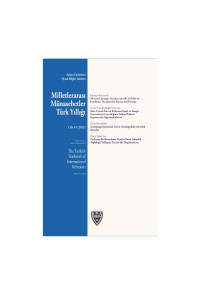
The journal of The Turkish Yearbook of International Relations, which is published by the Department of International Relations Faculty of Political Science Ankara University since 1960, is a refereed academic journal that publishes articles and book reviews in Turkish and English in the fields of Turkish Political Life, Turkish Foreign Policy and International Relations. All manuscripts sent to The Turkish Yearbook of International Relations are subject to the double blind peer review process.
Articles submitted to the Turkish Yearbook of International Relations should be original contributions and should not be under consideration for any other publication at the same time.
Manuscripts submitted to The Turkish Yearbook of International Relations will be sent to two referees after the initial evaluation by the Editorial Board. The Editorial Board will decide to accept, revise, reject, or send the manuscript to a third referee in line with the referee reports. The author will be notified of the decision as soon as possible.
1) Authors should submit the manuscripts in MS format (.docx) format via DergiPark. (https://dergipark.org.tr/en/pub/tyir)
2) Authors should state their titles, institutions, communication addresses, telephone numbers, e-mail addresses, and ORCID numbers in a separate file.
3) Submitted manuscripts should be between 6000-8000 words, including footnotes and bibliography. Book reviews should be between 1000-1500 words.
4) Each article should contain Turkish and English abstracts (approximately 100 words) and 3 to 5 keywords (in both Turkish and English).
5) Manuscripts should be written in Times New Roman with 1,5 line spacing and a font size of 12.
6) Quotations should be placed within double quotation marks. Quotations longer than four lines should be indented at left margin without quotation marks and single-spaced.
7) Citations within the text should be written in parentheses (APA) and references should also be arranged by using this citation system. Footnotes can be used for explanations that cannot be included in the main text. Footnotes should be written in Times New Roman, 10 font size.
Examples below are given to show how different sources should be written.
I. Citations in the Text
a) Books/Articles with a singular author:
(Fuller, 2008 : 25-27).
b) Multiple books/articles of an author in the same year:
(Prashad, 2017a : 47) ; (Prashad, 2017b : 68).
c) Books/Articles with two authors:
(Delanty and O’Mahony, 2002 : 13).
d) Books/Articles with more than two authors:
(Eralp et.al., 2011 : 44).
e) Institutional publications:
(OECD, 2010 : 112).
f) Internet sources:
(Roy, 2021).
Note :
If an article published in preprint version with DOI, the DOI and access date must be given.
II. Citation in the References
a) Books/Articles with a singular author:
Fuller, Graham E. (2008). The New Turkish Republic, (Washington D.C.: United States Institute of Peace Press).
b) Multiple books/articles of an author in the same year:
Prashad, Vijay (2017a). Red Star Over the Third World, (Delhi: Left Word Books).
Prashad, Vijay (2017b). The Darker Nations : A People’s History of the Third World, (New York: The New Press).
c) Books/Articles with two authors:
Delanty, Gerard and O’Mahony, Patrick (2002). Nationalism and Social Theory, (London : Sage).
Shapiro, Ian and Wendt, Alexander (1992). "The Difference that Realism Makes : Social Science and the Politics of Consent", Politics Society, 20 (2): 197-223.
d) Books/Articles with more than two authors:
Eralp, Atilla, İhsan D. Dağı, E. Fuat Keyman, Necati Polat, Oktay F. Tanrısever, Faruk Yalvaç and A. Nuri Yurdusevin (2011). Devlet, Sistem ve Kimlik (İstanbul: İletişim).
e) Institutional publications:
OECD (2010). World Development Report, 2009 (Paris).
f) Internet sources:
Roy, Arundhati (2021). "We Are Witnessing a Crime Against Humanity", https://www.theguardian.com/news/2021/apr/28/crime-against-humanity-arundhati-roy-india-covid-catastrophe (10.01.2022).
 December 12, 2025
Page
1-25
December 12, 2025
Page
1-25