The authors are cordially invited to submit their articles online in Microsoft Office Word format with a cover letter to the Toros University Journal of Food, Nutrition, and Gastronomy.
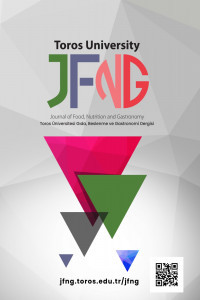
“Toros University Journal of Food, Nutrition, and Gastronomy” which started to be published in 2022 is an academic journal that carries out an international double-blind reviewing process that accepts original research articles, review articles, technical notes, and book reviews published twice a year, in June and December. All manuscripts are evaluated by the editor or section editors, editorial board and reviewers. The language of the journal is English. Turkish manuscripts are also included.
“Toros University Journal of Food, Nutrition and Gastronomy” (E-ISSN: 2979-9511) aims to contribute to the knowledge of science by publishing national and international scientific studies in the field of food, nutrition, dietetics, and gastronomy. The journal is an open access, free of charge, international peer-reviewed e-journal.
The journal emphasizes scientific research in food science, food technology, food chemistry, food microbiology, food engineering, food quality control, nutrition and dietetics, food and beverage culture from ancient times to the present, new trends in gastronomy, gastronomy tourism and product development in gastronomy science.
All manuscripts submitted for publication are evaluated by the editor or section editors, editorial board and reviewers.
Authors must demonstrate that the article is original (with less than 20% similarity in the iThenticate report). The full text should be added to plagiarism tools excluding references list.
If the article is derived from another source, name, institution, date and address of the original source should be specified.
The editorial board can make alterations in the content and format of the article with permission of the authors.
If there are previously published excerpts, tables, pictures, etc. in the article author(s) must obtain written permission from the copyright owner and authors and state this in the article. The author(s) is(are) responsible for obtaining the necessary permissions.
Compliance of the articles with scientific and ethical rules is the responsibility of the authors.
It is important that submitted articles are prepared in accordance with the rules stated below. For articles prepared without considering these rules, the reviewing process will not be started.
1. The submitted article should not contain any information about the authors. The corresponding author should prepare each author's name, title, institution information, full addresses, e-mail addresses, and ORCIDs as a second file other than the article file in the AUTHOR INFORMATION FORM and submit it.
2. COPYRIGHT TRANSFER FORM and PLAGIARISM REPORT (iThenticate) signed by all authors should be attached while submitting the article. The review process will not be started for articles if any of these files are missing and not prepared properly.
3. Toros University Journal of Food, Nutrition and Gastronomy requires that all research involving "human" and/or "animal" elements be in compliance with the provisions and principles of the Declaration of Helsinki (2013 revision), the Council of Higher Education Scientific Research and Publication Ethics Directive (dated 29.08.2012 and numbered 2012.18.946), the Guide for the Care and Use of Laboratory Animals (www.nap.edu/catalog/5140.html), the Regulation on the Working Principles and Procedures of the Animal Experiments Ethics Committees of the Ministry of Forestry and Water Affairs (dated 15 February 2014 and numbered 28914) and the Regulation on Clinical Research on Pharmaceuticals and Biological Products of the Ministry of Health (dated 13.04.2013 and numbered 28617). In such studies, authors must clearly state in the “Materials and Methods, Ethical Aspects of the Research” sections of their articles that the study was conducted in accordance with these rules and that they received approval from their institution’s ethics committees (with the committee name, date and number). The ethics committee decision must be uploaded as an attachment.
In addition, in studies involving a “human” element, authors must state in the “Materials and Methods - Ethical Aspects of the Research” section that “Informed Consent” was obtained from the research participants. For individuals who do not have decision-making capacity (e.g. children, unconscious patients, etc.), information must be provided that informed consent was obtained from the participant’s parents or first-degree responsible persons.
Example: This study obtained ethical approval from the Ethics Committee of ......... University with decision number …, reference number ..., and dated ../../202.... Written/verbal informed consent was obtained from all participants before initiation.
4. All files should be prepared in Microsoft Office Word format.
5. Articles can be in Turkish or English.
6. Articles should be prepared in a single column in accordance with the Article Template File.
ARTICLE TEMPLATE FILE
7. All texts should be prepared in 12-point Times New Roman font. The reference list, abstract, extended abstract (only for articles written in Turkish) should be 1 spaced and 1.15 spaced in the main text. Text should not contain indented paragraphs and paragraphs should be clarified by leaving 1 line (6pt) space. In the references list, 1 line (6pt) space should also be left between the references. (Paragraph-Indent and Spacing-Space-Before-0, After-6 pt in Office).
8. All margins of the page should be 2.5 cms.
9. The total length of any submitted article should not exceed 25 (A4) pages.
10. Line numbers must be added (Layout-Line numbers-Continuous in Microsoft Office Word). No footer, header or page number should be included.
11. In the article that does not include the author names; title, abstract, keywords, extended abstract in English if the language of the article is Turkish, main text (introduction and purpose, materials and methods, findings, discussion, conclusion, author contribution, conflict of interest, funding support if any and acknowledgment information), references and appendices should be included.
12. The title of the article should be centered above the abstract and only the first letter of the first word and proper names should be capitalized. The title should be written in Times New Roman, bold, 12 points.
13. Articles should include Turkish and English abstracts and should be on separate pages in the main text file. Turkish and English abstracts should be at least 150 and at most 250 words long for all article types. In articles written in English, the Turkish abstract should come after the English abstract, and in articles written in Turkish, the English abstract should be followed by an English abstract and then an extended English abstract of at least 1000 and at most 1200 words.
In research articles, the Abstract and abstract sections should be structured under the following subheadings: Objective, Material and Method, Results, and Conclusion. However, in reviews and case reports, summaries should be written in an unstructured manner.
The first line of the paragraphs in the abstract text should be left-aligned and should not be indented. In addition, no references should be given in the abstracts and no abbreviations should be included.
14. Extended abstracts may contain figures, tables, formulations or pictures. Also, graphical abstract can be added. The extended abstract should include all the subtitles of the main text (introduction and aim, materials and method, results, discussion and conclusion). In the extended abstract of the review articles, the method of the literature review (which databases are used, what kind of sources are accessed, etc.), the aim and the general trend of the results should be briefly stated. Level 1, level 2, level 3 headings can be applied as needed (item 16). In-text citations should be made in accordance with the reference writing rules (in the next section), and the references should be the same as the main text.
15. At the end of the abstracts (Turkish and English), there should be at least three and at most five keywords selected in accordance with MESH-Medical Subject Headings (https://meshb.nlm.nih.gov/search). The first letter of the first keyword should be capitalized, the first letter of the other keywords should be lowercase, a comma should be used between words, and a period should be placed after the last word.
16. Titles
Title Naming
• Level 1 Headings: (name of the article, abstract, introduction, materials and method, results, discussion and conclusion, references, appendices)
Centered, Bold and Words Begin with Upper Case, Continue with Lower Case Characters.
• Level 2 Headings:
Lean to the Left, Bold, Words Begin with Upper Case, Continue with Lower Case Characters
• Level 3 Headings:
Indented (1.25 cm), bold; the first word begins with upper case and continue with lower case and the rest is with lower case.
• Level 4 Headings
Indented (1.25 cm) bold, italic; the first word begins with upper case and continue with lower case and the rest is with lower case.
• Level 5 Headings
Indented (1.25 cm), italic; the first word begins with upper case and continue with lower case and the rest is with lower case.
Headings should not be numbered.
← One line should be left blank between sections and following level 1 headings.
17. Tables and Figures:
All tables, figures and graphics should be titled and numbered. The titles of tables and figures should be written on the tables or figures, aligned to the left, 12 pt, Times New Roman font, and lowercase letters other than the first letter of the first word. Information on tables or figures or references, if any, should be written under the table in 10-point Times New Roman font
Tables can be prepared smaller than the font used throughout the text. Figures or pictures must have sufficient resolution.
Tables and graphics should be added directly.
← The section should be separated from the text by a blank line.
18. If the information is to be transmitted with bullets;
• This bullet is used.
The following rules should be followed for the articles.
Introduction
In the introduction section, the literature on which the study is based should be briefly summarized. In the last paragraph, the purpose(s) of the study should be clearly stated.
← The section should be separated from the text by a blank line.
Materials and Methods
The selection and characteristics of the participants, the nature of the study, the methods used and the data analysis should be clearly stated. For clinical and experimental studies requiring ethical committee approval, the approval must include the name of the ethics committee, decision number, and date. The subtitles can be arranged according to the characteristics of the study.
← The section should be separated from the text by a blank line.
Results
The findings of the study should be clearly expressed. Where necessary, the findings can be supported by tables, graphs, figures or drawings.
← The section should be separated from the text by a blank line.
Discussion and Conclusion
The findings should be evaluated by the relevant literature. The limitations of the study should be given in this section. The results of the study and the contribution of the study to the literature and / or clinic should be briefly summarized and written as the conclusion paragraph.
← The section should be separated from the text by a blank line.
Author Contribution
In its commitment to providing an ethical, transparent and fair peer review and publication process, this journal adopts the CRediT (Contributor Roles Taxonomy) system, which includes 14 roles (Conceptualization, Data curation, Formal analysis, Funding acquisition, Research, Methodology, Project administration, Resources, Software, Supervision, Validation, Visualization, Writing – original draft, Manuscript review and editing) to describe the contributions of each author.
Example: Conceptualization: ÖÖA, EA, MVY; Data curation: EA, MVY; Formal analysis: ÖÖA; Funding acquisition: EA; Research: ÖÖA, EA, MVY; Methodology: EA, MVY; Project administration: ÖÖA; Resources: EA, ÖÖA; Software: ÖÖA, EA, MVY; Supervision: EA, MVY; Validation: ÖÖA; Visualization: ÖÖA; Writing – original draft: ÖÖA, EA; Writing review & editing: EA, MVY etc.
← Sections should be separated by a blank line.
Acknowledgements
Persons, institutions or organizations that have a direct contribution to the study should be mentioned in this section.
← The section should be separated from the text by a blank line.
Financial support
If financial support has been provided for the study, it should be mentioned (institution name, project number) in this section.
← The section should be separated from the text by a blank line.
Conflict of Interest
If any financial support (in cash or in kind) has been provided for the submitted research, the authors must state whether there is any relationship of interest between the institutions providing this support and the authors, and if so, the type of relationship.
No payment or consideration is requested for articles published in the journal. The editorial board assumes that the authors agree not to send the articles they submit to the journal to another journal before the evaluation process is completed. The compliance of the articles with ethical, scientific, legal and similar rules is entirely the responsibility of the authors.
If there is no conflict of interest, the phrase 'The authors declare that they have no conflict of interest.' should be added.
In addition, the “Article Copyright Transfer Form” in the article tracking system must be filled out and signed by all authors and uploaded to the system.
← The section should be separated from the text by a blank line.
Reference List
Abbreviations that can be used in Citation
Term Abreviation
Edition ed.
Editor Ed.
Editors Eds.
No date n.d
Page p.
Pages pp.
And others et al.
Numbers should be used in in-text citation.
Some examples:
References are numbered in parentheses ( ) according to their order of appearance in the text. If the source is referred to again, the same number is used. Multiple references should be separated by commas. A hyphen is placed between more than two consecutive reference numbers.
…….that can be recycled to the food industry (10).
were in the range of 0.2–13.47% and 2.44–3.89%, respectively (9, 36, 37).
due to the presence of phenolic compounds in its content (47–49).
Bytyqi (7) aimed to increase the…
Kolakowski and Bernardo (9) determined the chemical composition…
Ozdemir et al. (8) used the crude fibre…
1. Articles
DOI number must be given in the reference list if available. Before the number, the phrase "doi:" should not be written. The DOI number must be given as a link. If there is no DOI link, the access link of the reference should be given.
Articles that are published, sent for publication, or in print should be cited as follows:
Main Format:
Author's Surname, Author's Names' Initials. (Year). Article title capitalize only the first word of the title and any proper nouns. Journal Name (Italic and First Letter of Each Word Capital), Volume (Italic) (Issue), Page Number Range. http://doi.org/xx.xxx/yyyyy
a. Published journal article: 1 author
İçerli, L. (2010). Örgütsel adalet: Kuramsal bir yaklaşım. Girişimcilik ve Kalkınma Dergisi, 5(1), 67-92. http://doi.org/...
Ayaşan, T. (2013). Effects of dietary inclusion of protexin (probiotic) on hatchability of Japanese quails. Indian Journal of Animal Science, 83(1), 78-81. http://doi.org/...
b. Published journal article: 2 authors
Cin, P., & Gezer, C. (2017). Fonksiyonel bir besin olarak turunçgiller ve metabolik sendrom ilişkisi. Food and Health, 3(2), 49-58.
Badem, A., & Alpkent, Z. (2018). Production of ice cream with carob bean pekmez (molasses). International Journal of Environment, Agriculture and Biotechnology, 3(1), 28-32. https://doi.org/10.22161/ijeab/3.1.5
c. Published journal article: 3-20 authors
Güneş, R., Palabıyık, İ., & Kurultay, Ş. (2018). Şekerleme teknolojisinde fonksiyonel ürün üretimi. Gıda, 43(6), 984-1001.
Ozdemir, Y., Oncel, B., & Keceli, M. (2021). Purification of crude fiber from carob molasses pulp and uses in traditional Turkish sucuk. International Journal of Gastronomy and Food Science, 25, 100410. https://doi.org/10. 1016/j.ijgfs.2021.100410
d. Published journal article: Article with 21 or more authors
Kalnay, E., Kanamitsu, M., Kistler, R., Collins, W., Deaven, D., Gandin, L., Iredell, M., Saha, S., White, G., Woollen, J., Zhu, Y., Chelliah, M., Ebisuzaki, W., Higgins, W., Janowiak, J., Mo, K. C., Ropelewski, C., Wang, J., Leetmaa, A., . . . Joseph, D. (1996). The NCEP/NCAR 40 yıllık reanalysis project. Bulletin of the American Meteorological Society, 77(3), 437–471. http://doi.org/fg6rf9
e. Articles in online magazines
Ak, Ö. (2019, 17 Nisan). Beyin hücrelerinde yeni bir iletişim şekli. Bilim ve Teknik. https://www.xxxx
Thomson, J. (2022, September 8). Massive, strange white structures appear on Utah’s Great Salt Lake. Newsweek. https://www.newsweek.com/mysterious-mounds-great-salt-lake-utah-explainedmirabilite-1741151
f. Articles in printed magazines
Henry, W. A. (1990, 9 Nisan). Making the grade in today's schools. Time, 135, 28-31.
Schaefer, N. K., & Shapiro, B. (2019, September 6). New middle chapter in the story of human evolution. Science, 365(6457), 981–982. https://doi.org/10.1126/science.aay3550
g. Online newspaper article:
Roberts, S. (2020, April 9). Early string ties us to Neanderthals. The New York Times. https://www.nytimes.com/2020/04/09/science/neanderthals-fiber-string-math.htm
h. Online newspaper article:
Carey, B. (2019, 22 Mart). Can we get better at forgetting? The New York Times. https://www.nytimes.com/2019/03/22/health/memory-forgetting-psychology.html
Roberts, S. (2020, April 9). Early string ties us to Neanderthals. The New York Times. https://www.nytimes.com/2020/04/09/science/neanderthals-fiber-string-math.htm
2. Books
DOI must be given, if available.
a. Printed Book
Main Format:
First Author's Surname, First Author's Names' Initials.,& Second Author's Surname, Second Author's Names' Initials. (Year). Book title (italic, capitalize only the first word of the title and any proper nouns). (Edition). Publisher.
http://doi.org/xx.xxx/yyyyy
Arlı, M., Şanlıer, N., Küçükkömürler, S., & Yaman, M., (2006). Anne ve çocuk beslenmesi (9. bs.). Pegem Akademi.
Stone, H., & Sidel, J. (2004). Sensory evaluation practices. (3rd ed.). Academic Press. https://doi.org/10.1016/B978-0-12- 672690-9.X5000-8
b. Printed Edited Book
Main Format:
Author's Surname, Author's Names' Initials. (Ed./Eds.). (Year). Book title (italic, capitalize only the first word of the title and any proper nouns). Publisher. http://doi.org/xx.xxx/yyyyy
Sönmez, P., Ünver, F., Demirtaş, S., Mete, A., Ebulfez, S. (Ed.). (2017). Uluslararası göç ve çocuklar, International Migration and Children. Transnational Press.
Torino, G. C., Rivera, D. P., Capodilupo, C. M., Nadal, K. L., & Sue, D. W. (Eds.). (2019). Microaggression theory: Influence and implications. John Wiley & Sons. https://doi.org/10.1002/9781119466642
c. Book Chapter
Main Format:
Author's Surname, Author's Names' Initials. (Year). Chapter title. In Editors’ Names’ Initials, Editors’ Surname (Ed./Eds.), Book title (italic, capitalize only the first word of the title and any proper nouns). (Edition, page range). Publisher http://doi.org/xx.xxx/yyyyy
Example: (3rd ed., p. 5).
Example: (3rd ed., pp. 5-84).
Dönmez, B. (2013). Motivasyon. S. Özdemir (Ed.), Eğitim yönetiminde kuram ve uygulama (s. 185-229) içinde. Pegem Akademi.
Aron, L., Botella, M., & Lubart, T. (2019). Culinary arts: Talent and their development. In R. F. Subotnik, P. Olszewski-Kubilius, & F. C. Worrell (Eds.), The psychology of high performance: Developing human potential into domain-specific talent (pp. 345–359). American Psychological Association. https://doi.org/10.1037/0000120-016
d. Book with electronic version only:
If the date of publication is unknown, use “n.d.” (no date) in parentheses.
Author, A. (n.d.) ...
O'Keefe, E. (n.d.). Egoism &the crisis in Western values. http://www.onlineoriginals.com/showitem.asp?itemID=135
e. Electronic version of the printed book:
Morville, P., & Rosenfeld, L. (2006).
Information architecture for the World Wide Web [Adobe Digital Editions sürümü]. http://shop.oreilly.com/home.do
Shotton, M. A (1989).
Computer addiction? A study of computer dependency [DX Reader version].
http://www.ebookstore.tandf.co.uk/html/index.asp
3. Master's and Doctoral Theses/Dissertation
a. Theses/Dissertation retracted through a database
Main Format:
Author's Surname, Author's Names' Initials. (Year). Title (Publication No. xxxx) [Master's Thesis/Doctoral Dissertation, University]. Retracted database/Web-site.
İlhan, S. (2013). Production of bakery products added carob (Locust bean) ( Publication No. xxxx) [Master’s thesis, Mersin University]. YOK Thesis Centre.
Kabir, J. M. (2016). Factors influencing customer satisfaction at a fast food hamburger chain: The relationship between customer satisfaction and customer loyalty (Publication No. xxxx) [Doctoral dissertation, Wilmington University]. ProQuest Dissertations & Theses Global.
b. Unpublished Theses/Dissertation:
Main Format:
Author's Surname, Author's Names' Initials. (Year). Title [Unpublished Master's Thesis/Doctoral Dissertation]. University.
Harris, L. (2014). Instructional leadership perceptions and practices of elementary school leaders [Unpublished doctoral dissertation]. University of Virginia.
4. Presentations
Main Format:
Author's Surname, Author's Names' Initials. (Year, month day). Title [Conference presentation]. Name of the scientific meeting, City, Country.
Gülcü M, Demirci A.Ş., &Güner, K.G. (2008, May 21-23). Siyah Üzüm; Zengin Besin İçeriği ve Sağlık Acısından Önemi. [Conference presentation]. Türkiye 10. Gıda Kongresi, Erzurum, Türkiye.
Evans, A.C., Jr., Garbarino, J., Bocanegra, E., Kinscherff, R. T., & Marquez-Greene, N. (2019, August 8-11). Gun violence: An event on the power of community [Conference presentation]. APA 2019 Convention, Chicago, IL, United States. https://convention.apa.org/2019-video.
5. Web pages and websites
a. Web Page of the News Site
Toner, K. (2020, September 24). When Covid-19 hit, he turned his newspaper route into a lifeline for senior citizens. CNN. https://www.cnn.com/2020/06/04/us/coronavirus-newspaper-deliveryman-groceries-senior-citizens-cnnheroes-trnd/index.html
b. Webpage on a website with a government agency group author
National Institute of Mental Health. (2018, July). Anxiety disorders. U.S. Department of Health and Human Services, National Institutes of Health. https://www.nimh.nih.gov/health/topics/anxiety-disorders/index.shtml
c. Webpage on a website with an organizational group author
World Health Organization. (2018, May 24). The top 10 causes of death. https://www.who.int/news-room/fact-sheets/detail/the-top-10-causes-of-death
d.Webpage with a retrieval date
If the date of publication is unknown, use “n.d.” (no date) in parentheses.
Author, A. (n.d.) ...
U.S. Census Bureau. (n.d.). U.S. and world population clock. U.S. Department of Commerce. Retrieved January 9, 2020, from https://www.census.gov/popclock/
6. Reports
a. Report by a government agency references
National Cancer Institute. (2019). Taking time: Support for people with cancer (NIH Publication No. 18-2059). U.S. Department of Health and Human Services, National Institutes of Health. https://www.cancer.gov/publications/patient-education/takingtime.pdf
b. Report with individual authors references
Maurer, M., Dardess, P., Carman, K. L., Frazier, K., &Smeeding, L. (2012). Guide to patient and family engagement: Environmental scan report (Publication No. 12-0042-EF). American Institutes for Research, Agency for Healthcare Research and Quality. https://www.ahrq.gov/research/findings/final-reports/ptfamilyscan/index.html
7. Dictionaries
If the date of publication is unknown, use “n.d.” (no date) in parentheses.
Author, A. (n.d.) ...
a. Online dictionary
American Psychological Association. (n.d.). Just-world hypothesis. In APA dictionary of psychology. Retrieved January 18, 2020, from https://dictionary.apa.org/just-world-hypothesis
b. Printed dictionary
Example: (3rd ed., p. 118).
American Psychological Association. (2015). Mood induction. In APA dictionary of psychology (2nd ed., p. 667).
Merriam-Webster. (2003). Litmus test. In Merriam-Webster’s collegiate dictionary (11th ed., p. 727).
8. Wikipedia
Yağlıboya. (2019, 8 December). In Wikipedia .https://en.wikipedia.org/w/index.php?title=Oil_painting&oldid=929802398
9. PowerPoint Slides or Lecture Notes
Jones, J. (2016, March 23). Guided reading: Making the most of it [PowerPoint slides]. SlideShare. https://www.slideshare.net/hellojenjones/guided-reading-making-the-most-of-it
10. ISO Standards
International Organization for Standardization. (2018).
Occupational health and safety management systems—Requirements with guidance for use (ISO Standard No. 45001:2018).
https://www.iso.org/standard/63787.html
 December 31, 2025
Page
109-122
December 31, 2025
Page
109-122