PUBLICATION ETHICS, MALPRACTICE STATEMENT AND PUBLICATION PROCESS
Anadolu Journal of Educational Sciences International (AJESI) is an academic journal published biannually by the Graduate School of Educational Sciences at Anadolu University located in Eskisehir, Türkiye. At AJESI, we attach high importance to the integrity of our academic content, publication ethics and process as well as maintaining authors’ research integrity. We also do our best to follow the guidelines and resources provided by the Committee on Publication Ethics (COPE) to reach and maintain international publication standards.
This section outlines our basic principles that we apply to our journal, which we believe will be useful for researchers and authors who wish to publish their articles in our journal.
Publication EthicsAJESI editors take serious measures to identify and prevent the publication of papers where research misconduct has occurred, and thus they do not encourage such misconduct, or knowingly allow such misconduct to take place. If AJESI editors identify or have grounds for suspecting research misconduct, they will deal with allegations appropriately. AJESI and its editors are always willing to publish corrections, clarifications, retractions and apologies when needed.
Authors have the right to request withdrawal, retraction or correction(s) of their articles any time before they are published. However, they can only request retractions or corrections of their articles in five days after their article is published in an issue. Otherwise, they will have to write a correction notice, which will be published in the next issue. Withdrawal is possible at any stage before publication.
AJESI never tolerates plagiarism and self-plagiarism; and has the right to check all submissions using tools such as Turnitin and Ithenticate. AJESI accepts manuscripts up to a maximum similarity rate of 10% (excluding references and direct citations). Except for exceptional cases, this limit cannot be exceeded, and any submitted article that has a higher rate of similarity mentioned here will be rejected.
Editorial Board and Editorial ProcessAJESI works with experts from a wide range of areas in the context of educational sciences. These experts compose the body of our management board, advisory board and editorial board. These boards are also responsible for recommending, contacting, assigning reviewers, or approving the final version of the manuscripts before they are published. Manuscripts that are submitted for evaluation go under rigorous initial screening for compliance with our publication ethics and malpractice statement under the supervision of the Chief Editor. A list of our other editorial board members can be found here.
AJESI never discriminates against authors, editors or peer reviewers based on personal characteristics or identity. However, it embeds diversity and promotes equity at every stage of evaluation and publication. Additionally, AJESI never tolerates inappropriate behavior or correspondence towards its staff. If this is the case, AJESI holds the right to act to protect others from this abuse, which includes withdrawal of a manuscript from consideration. If AJESI identifies malpractice in the manuscripts submitted or articles published, the management board and the editorial board will deal with the issue immediately and can take action including withdrawal, retraction or correction.
The Management Board takes good publication practices seriously and follows the guidelines provided by Committee on Publication Ethics (COPE) on publication ethics such as peer reviews, ethical guidelines for peer reviewing, editing peer reviews, and Handbook for Journal Editors (INASP, 2018) Basically, these good practices may include editorial board participation, edition of peer reviews, managing the relationship between the reviewers, authors and/or editorial board members, sharing of information among editors-in-chief regarding possible misconduct, authorship disputes, ethical editing, and retraction.
Authors and Authors' ResponsibilitiesFor the authors, AJESI, where no other guidance is specified, recommends applying the following principles before they submit their manuscripts.
• AJESI does not charge any article submission, editorial processing, article publication (page or color), or subscription charges, which means that upon reviewers’ positive evaluation and approval, all the accepted manuscripts are published without any charges.
• Any person who contributed to the conduct of the research and/or its manuscript including the design, acquisition, analysis, or interpretation of data for the work, drafting or revising it critically, or final revision should be listed as an author. Authors’ names and surnames, affiliations, e-mail addresses, ORCIDs must be clearly stated as footnotes if their manuscript is accepted and approved for publication.
• The corresponding author is responsible for manuscript correction and proofreading, agreeing to and signing the Author Publishing Agreement, Author Contribution Form, and Author Contact Form on behalf of relevant co-authors and/or arranging for any third-party copyright owners’ signature, and acting on behalf of all co-authors in responding to queries from all sources post-publication.
• All the authors must participate in peer review process after they receive feedback from the reviewers; declare they contributed to the research; provide retractions or corrections of mistakes in five days when their article is published; and must provide a list of references, financial support, and statement of conflict of interest.
• Authors cannot publish the same research in more than one journal, thus they must declare that their articles are original and have not been published previously or are not under consideration of publication elsewhere.
• For research including animals and/or human participants, an Ethics Committee Approval Certificate must be obtained and then uploaded to the manuscript submission system as a supplementary file. In addition, it must be stated on the first page of the article that ethics committee approval was obtained as a footnote. In the method section of the study, it must be clearly presented from which institution, on which date, and with which decision or which issue number the approval was obtained.
Authors have the right to complain about any issue or stage of the evaluation or publication, including reviewer bias and competitive harmful acts by reviewers, directly to the Chief Editor. If this is required, the author(s) should include the details of their complaint and provide evidence to solve the dispute in a short time and effectively.
Ethical PrinciplesWhen authors submit their manuscript, they must also submit an Ethics Committee Approval Document as a supplementary file. Additionally, authors must share information about the ethics committee approval that they obtained including institution name, issue date, and issue number.
Plagiarism Screening PolicyWhen authors submit their manuscript, they must also submit a plagiarism report. If their manuscript is accepted for publication, authors must also submit the plagiarism report of their revised manuscript later.
Anadolu Journal of Educational Sciences International (AJESI) accepts and publishes articles up to a maximum similarity rate of 20% (excluding list of references and direct quotes) using Turnitin and IThenticate software. Except for special cases, this limit cannot be exceeded, and any submitted manuscript that has a higher rate of similarity than mentioned here can be rejected (editorial or desk rejection).
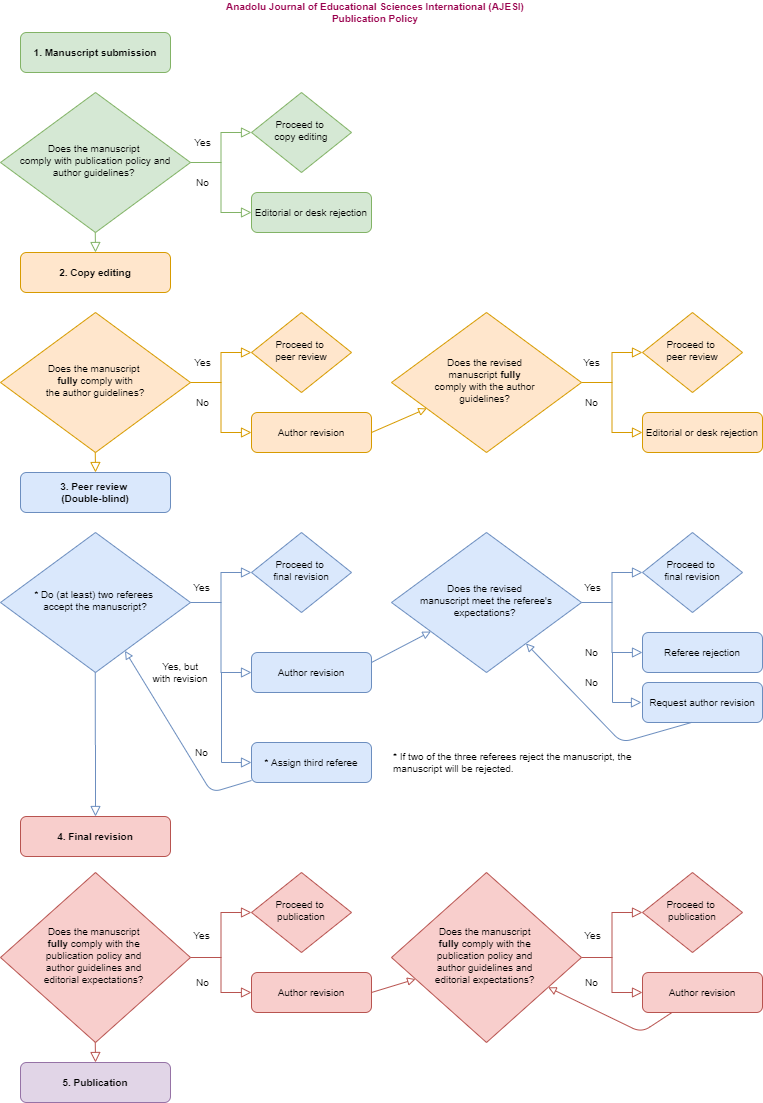
Peer Review ProcessAJESI adheres strictly to the double-blind peer review process explained below in cooperation with the corresponding author. The editors are jointly responsible for the content of the journal. Although peer reviewers may advise them, the decision over what to publish lies with the editors.
Phase 1. The author submits their manuscript.
o If the manuscript complies with AJESI publication policy and author guidelines, Phase 2 starts in 15 days.
o If not, the manuscript is rejected.
Phase 2. A copy editor checks if the manuscript fully complies with AJESI writing rules and academic research reporting standards.
o If yes, Phase 3 starts in seven days.
o If not, the author is asked to revise and resubmit their manuscript in seven days. After the second revision, if the manuscript fully complies with AJESI writing rules and academic research reporting standards, Phase 3 starts in seven days.
o If the manuscript does not fully comply with AJESI writing rules and academic research reporting standards, the manuscript is rejected.
Phase 3. During double-blind peer review, two referees evaluate the manuscript in 15 days. If necessary, this duration is extended.
o If both of them reject it, the manuscript is rejected.
o If either of them rejects it, a new referee is assigned. If the third referee rejects it, the manuscript is rejected and referees’ feedback is sent to the author.
o If the third referee accepts or recommends revision, the manuscript is accepted. However, in any case when the manuscript is accepted or revision is recommended, the author revises the manuscript based on the referees’ and/or editors’ feedback in 15 days. Revision and/or re-evaluation continues until all the referees and/or the editor confirms the manuscript complies with the feedback given and academic research writing standards. Only after this process is completed, can Phase 4 start.
Phase 4. The author sends the fully revised and publication-ready version of their manuscript in 15 days.
o If it meets all of the journal’s the publication policy and publication ethics criteria, AJESI writing rules, and editorial expectations, the manuscript is printed in a following issue.
o If it doesn’t meet all of the journal’s publication policy and publication ethics criteria, writing rules, and editorial expectations, the author revises the manuscript until it is approved by the copy editor and the editor. Then, it is published in a following issue.
Reviewers are responsible for maintaining an objective evaluation process and they should not have any conflict of interest. Additionally, they are expected to improve the quality of the manuscripts by recommending relevant published work (maybe not yet cited). It is also the responsibility of the editor of the manuscript and the reviewers to treat the assigned manuscript confidentially before publication. Reviewers can also complain about any research issue that they identify including plagiarism, duplicate or concurrent publication, simultaneous publication, research errors, research standard violations, and undisclosed conflicts of interest directly to the Chief Editor. If this is required, the author(s) should include the details of their complaint and provide evidence to solve the dispute in a short time and effectively.
* Articles with positive evaluations of referees and editors by December 1 may be published in an issue starting from January issue in the following calendar year.
* Articles with positive evaluations of the referees and editors by June 1 may be published in July in the same calendar year or in an issue in the following calendar year.
* AJESI reserves the right to determine the publication date of the articles.
Article Submission, Editorial Processing, and Article Publishing Charges
Anadolu Journal of Educational Sciences International (AJESI) does not charge any article submission, editorial processing, or article publication charges (page or color). In other words, upon reviewers’ evaluation and approval as well as editorial board’s approval, all the accepted articles are published without any charges.
Copyright Policy
Authors retain the copyright of their papers without restrictions, but they are responsible for the content of their article published in the journal and accept AJESI’s publication and open access policy.
Authors confirm that their articles' content does not bind the owner, editor, co-editors, or advisory board members Anadolu Journal of Educational Sciences International (AJESI).
Authors also declare that their articles are original and have not been published previously or are under consideration of publication elsewhere.
Any submitted manuscript that does not meet the criteria explained in this section can be rejected (editorial reject or desk reject).
Open-access and Licensing Policy
Anadolu Journal of Educational Sciences International (AJESI) is a fully open-access journal and it provides free and unlimited access to the articles that it publishes without any form of restriction, subscription, or requirement. This open-access policy results in higher visibility, readership and citation. An open-access policy also helps disseminate knowledge as widely as possible.
Anadolu Journal of Educational Sciences International (AJESI) and the author(s) of the articles printed in AJESI let researchers remix, adapt, and build upon the articles published on its website non-commercially. All the articles published on the Anadolu Journal of Educational Sciences International (AJESI) website are licensed under a Creative Commons Attribution-NonCommercial-ShareAlike 4.0 International License (CC-BY-NC-SA).
Archiving
AJESI uses DergiPark hosting services and editorial workflow management system provided by TÜBİTAK ULAKBİM. DergiPark system saves each document and manuscript uploaded to the system electronically. Additionally, the editors who are assigned to manage the workflow of manuscripts are individually responsible for saving and backups, which is supervised by the Chief Editor. In the event that AJESI starts to use a different hosting service and an editorial workflow management system, all the backups will be transferred to that system and access to the new website will be preserved. In the event the journal is no longer published, it will still be preserved on its web page on DergiPark with all the previous issues.
Ownership and Management
AJESI is published by the Graduate School of Educational Sciences, Anadolu University, which is a state university in Eskişehir/Türkiye.
The Rector, Prof. Dr. Fuat ERDAL, owns the journal. The Chief Editor, Prof. Dr. Işıl KABAKÇI YURDAKUL is responsible for coordinating all the management and editorial processes.
For more detailed information about the Management Board and Editorial Board, please click here.
Website
AJESI is hosted, managed and published electronically on https://dergipark.org.tr/en/pub/ajesi. On this website, researchers and readers can reach the archive of previous issues and other useful information regarding journal info, editorial processes, and publication.
AJESI Management Board editors do their best to ensure high ethical and professional standards and keep the website up-to-date.
Publishing Schedule
(AJESI) is a biannual electronic academic journal published in January and July.
Name of the Journal
Anadolu Journal of Educational Sciences International (AJESI) is published with e-ISSN: 2146-4014.

 July 30, 2024
Page
475-500
July 30, 2024
Page
475-500
