2026
Publication Type
Dose dependent phytotoxic effects of Cd, Ni, and Cu on cauliflower in vitro
Effects of pesticide seed treatments on seed yield and oil quality of sunflower (Helianthus annuus L.)
Effect of intercropping and sowing methods on yield and yield components of sorghum (Sorghum bicolor var. Abu Sabeen)
Diversity and pathogenicity differences among Acidovorax citrulli strains causing bacterial fruit blotch in cucurbit crops
Effects of micronized calcite, hoagland solution and Ascophyllum nodosum extract on acclimatization and vegetative growth of in vitro-derived Phalaenopsis spp.
Comparative nutritional and fatty acid profiling of commercially roasted watermelon seeds from different regions of Türkiye
Response of oilseed flax (Linum usitatissimum L.) to seeding rate in Aegean Coastal Zone
Comprehensive evaluation of biochemical profiles and antioxidant potential in Rosehip (Rosa canina L.) genotypes in Türkiye
Effects of different LED light spectra on growth and quality parameters of Tulip (Tulipa spp.)
Optimization of ultrasound-assisted grape vinegar fortified with olive leaf powder: effects on bioactive and functional properties
Evaluation of fermentation efficiency and ethanol production potential of sweet sorghum genotypes in Çukurova region of Türkiye
The global nitrogenous fertilizer market: a trade-based analysis of market attractiveness and trade vulnerability
Correlation and regression analysis for seed cotton yield in cotton (Gossypium hirsutum L.)
Estimation of egg albumen height in Nick Brown hens: A comparison of Ridge and LASSO regression methods
Determination of the effects of cover crops on yield and pomological characteristics of ‘Meyer’ lemon
Multivariate analysis of physicochemical quality parameters and production yield in sustainable sugar processing
Pomological and biochemical characterization of Musa acuminata ‘Dwarf Cavendish’ and Musa acuminata ‘Red Dacca’ banana cultivars
Nutritional quality and food safety evaluation of granola products in Türkiye using nutri-score and acrylamide levels
Effects of organic and inorganic fertilizers on wheat growth, oxidative stress and soil microbial activity under water deficit conditions
Impact of oat protein fortification on physicochemical stability and microbial viability in dairy-based kefir
Phytochemical characterization and bioactivity evaluation of extracts from different parts of Salvia ceratophylla
Performance evaluation of deep learning models against IC-RT-PCR for accurate and cost-effective PVY detection
Effects of potassium application timing and humic acid on cotton yield and fiber quality traits
Comparative expression analysis of Myb1, Myb14, and Myb15 genes in leaf tissues of grapevine rootstocks under long-term drought stress
Effect of different pyrolysis temperatures on biofertilizer properties of microalgal biochar and energy analysis
Aim
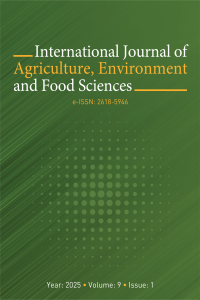
The International Journal of Agriculture, Environment and Food Sciences (e-ISSN: 2618-5946) aims to disseminate original, high-quality, and impactful research that advances scientific understanding and provides innovative solutions to global challenges in agriculture, environmental systems, and food sciences.
The journal serves as an international and multidisciplinary platform for researchers, academicians, professionals, and policy-makers to share knowledge, foster collaboration, and contribute to the sustainable transformation of agri–food–environment systems.
The journal particularly welcomes applied, interdisciplinary, and solution-oriented studies that contribute to:
- Sustainable and climate-smart agricultural practices
- Environmental conservation, biodiversity protection, and climate resilience
- Food security, safety, and nutrition
- Smart farming, digital agriculture, and agri-technological innovation
- Integrated ecosystem approaches and the circular bioeconomy
Submissions aligned with global scientific and policy priorities—such as the United Nations Sustainable Development Goals (SDGs), climate change mitigation, or sustainable food systems—are strongly encouraged.
The journal gives priority to original research articles presenting novel data, methods, or analytical approaches with strong theoretical and practical implications. Review articles, short communications, and case studies are also considered when they provide significant contributions.
All manuscripts undergo a rigorous double-blind peer review process and are published in accordance with internationally recognized standards of editorial independence, research ethics (COPE), and open access principles (BOAI).
Scope
The scope of the journal includes, but is not limited to, the following areas:
Agricultural Sciences
- Agronomy and Crop Science
- Horticulture and Viticulture
- Plant Breeding, Genetics, and Genomics
- Soil Science, Fertility, and Plant–Soil Interactions
- Agricultural Biotechnology, Omics, and Molecular Biology
- Precision Agriculture, Smart Farming, and Digital Technologies
- Organic and Sustainable Farming Systems
- Agricultural Machinery, Engineering, and Automation
- Agricultural Economics, Policy, and Rural Development
Animal and Aquatic Sciences
- Animal Husbandry and Production Systems
- Veterinary Science and Animal Health
- Aquaculture and Fisheries Science
- Animal Nutrition, Welfare, and Breeding Systems
- Reproductive Technologies in Livestock
Environmental and Ecological Sciences
- Environmental Impact and Risk Assessment
- Climate Change Mitigation and Carbon Management
- Land Use, Landscape Ecology, and Agroecosystem Sustainability
- Water Resources, Irrigation, and Sustainable Management
- Waste Management, Pollution Control, and Environmental Engineering
- Ecosystem Services, Agroecology, and Biodiversity Conservation
- Circular and Climate-Smart Agriculture
Food Science and Human Nutrition
- Food Chemistry, Processing, and Engineering
- Food Safety, Hygiene, and Quality Assurance
- Functional Foods, Nutraceuticals, and Health Impacts
- Postharvest Physiology, Packaging, and Storage Technologies
- Sustainable Food Systems and Supply Chains
- Food Waste Valorization and Novel Food Technologies
- Human Nutrition and Public Health
The journal also welcomes interdisciplinary submissions that integrate biological, technological, environmental, and socio-economic perspectives to address complex challenges at the agriculture–environment–food nexus.
Author Guidelines
The International Journal of Agriculture, Environment and Food Sciences is a peer-reviewed, open-access journal
that publishes original research in agriculture, environmental sciences, and food sciences. Authors must follow the
guidelines below to ensure transparency, ethics, and consistency in the publication process.
Scope of Submissions
The journal accepts only Original Research Articles that contribute significantly to scientific advancement
within its scope.
Language and Formatting Requirements
Language: English
File format: Microsoft Word (.doc or .docx)
Font: Times New Roman, 10 pt
Line spacing: Single (1.0) line spacing throughout the text,
Margins: 1.8 cm on all sides

Page orientation: Portrait (A4)
Units: SI units (temperatures in °C)
Title: Max 15 words, bold, 16 pt, justified
Author names: Full names.
Affiliations: University, Faculty, Department, City, Country
Manuscript Structure
Manuscripts should follow this structure:
Title
Author names and affiliations
Abstract (max 300 words, no citations)
Keywords (3–6, alphabetical order)
Introduction
Materials and Methods
Results and Discussion
Conclusion
Compliance with Ethical Standards
References (APA 7th edition)
Author names and affiliations are included in the manuscript file at submission.
However, for double-blind peer review, all identifying information is removed
by the Editorial Office before the manuscript is sent to reviewers.
Compliance with Ethical Standards
All manuscripts must include a Compliance with Ethical Standards section addressing:
Conflict of Interest
Author Contributions
Ethics Committee Approval
Consent to Participate / Publish
Funding
Data Availability
Generative AI Statement
Acknowledgments
Manuscript Submission
Manuscripts must be submitted via the online system:
Submit your manuscript
Required submission files:
Incomplete submissions will not proceed to peer review.
Peer Review Policy
Double-blind peer review by at least two independent reviewers
Typical review time: 4–8 weeks

Final decision by Editor-in-Chief based on scientific merit and reviewer feedback
Copyright and Licensing
Authors retain full copyright of their work. Upon acceptance, they grant the journal a non-exclusive license to publish and distribute the article under the Creative Commons Attribution 4.0 International License (CC BY 4.0)
Download Copyright and License Agreement
Editorial Processing Charges (EPC)
An Editorial Processing Charge (EPC) is required upon submission to cover administrative and technical costs
(editorial management, formatting, DOI registration, and hosting). This fee is non-refundable and must be paid by the
corresponding author or their institution before peer review begins.
The journal does not charge submission fees or Article Processing Charges (APC).
See current rates on the Price Policy page.
Templates and Supporting Documents
Contact
📧 editorialoffice@jaefs.com
📱 WhatsApp: +90 850 309 59 27
🌐 https://dergipark.org.tr/jaefs
Ethical Principles and Publication Policy
The International Journal of Agriculture, Environment and Food Sciences is committed to the highest standards of research and publication ethics in line with
COPE, ICMJE, CSE, EASE, and NISO. The journal adheres to the
Principles of Transparency and Best Practice in Scholarly Publishing (DOAJ, COPE, OASPA, WAME). This policy defines the ethical responsibilities of authors, reviewers, editors, and the publisher to ensure integrity, transparency, objectivity, and accountability.
General Ethical Standards
- Only original, unpublished, and high-quality manuscripts are considered.
- Plagiarism, data fabrication/falsification, duplicate/overlapping publication, image manipulation, citation manipulation, and unethical experimentation are prohibited.
- All submissions undergo plagiarism screening (e.g., iThenticate, intihal.net); editors evaluate reports holistically.
- Human/animal studies must include required ethical approvals, consent, and compliance with international guidelines.
Authorship, Contributions, and Acknowledgements
- Authorship follows ICMJE criteria; all four conditions must be met.
- Use the CRediT taxonomy to declare individual contributions.
- Non-author contributors should be acknowledged with consent; ghost/guest/gift authorship is unacceptable.
Data Availability, Materials, and Reproducibility
- Provide a Data Availability Statement indicating access to data, code, and materials (repository link or justified restrictions).
- Deposit datasets/code in recognized repositories and cite persistent identifiers when applicable.
Preprints and Prior Dissemination
- Submissions previously posted as preprints are allowed with disclosure at submission; update the preprint with the article DOI upon acceptance.
- Conference abstracts/theses are acceptable but overlap must be disclosed.
Editorial and Peer Review Process
- Double-blind peer review with at least two independent reviewers and oversight by an editorial board member.
- Decisions are based on scientific merit, originality, and relevance to scope.
- Submissions from editors/board members are handled independently.
Responsibilities of Authors
- Ensure originality, accurate citation, ethical conduct, and compliance with approvals/consents.
- Disclose all funding sources and conflicts of interest.
- Provide transparent methodology; share data/code as stated; cooperate in post-publication actions.
Responsibilities of Reviewers
- Provide constructive, objective, timely reviews; keep confidentiality; avoid personal criticism.
- Declare conflicts and recuse when needed; report suspected ethical issues.
Responsibilities of Editors
- Ensure fair, unbiased, and timely decisions; safeguard confidentiality; manage conflicts of interest.
- Follow COPE flowcharts for suspected misconduct; uphold academic integrity.
Research Involving Humans and Animals
- Human studies: IRB/ethics approval (name/ID), informed consent, clinical trial registration (where applicable), and permissions for identifiable data/images.
- Animal studies: Institutional approval and compliance with international standards (e.g., ARRIVE); minimize suffering and justify procedures.
Conflict of Interest and Funding Disclosure
- Declare all financial and non-financial conflicts (employment, consultancies, stock, patents, grants, personal relationships, academic competition).
- State funders and their role in study design, analysis, and publication.
Use of Generative AI and AI-Assisted Tools
- AI tools cannot be authors. Disclose tool name/version and purpose (e.g., language editing) in the manuscript; authors remain fully responsible for accuracy/integrity.
- No fabricated data/references/images; no privacy/confidentiality breaches.
Open Access, Licensing, and Revenue Sources
Articles are published under a Creative Commons Attribution 4.0 International License (CC BY 4.0). The journal is fully open access (no paywalls). No submission fee or APC is charged. An Editorial Processing Charge (EPC) is requested prior to peer review to support editorial/technical operations; waiver/discount options are available (see Price Policy).
The journal does not carry advertising or sponsored content that could compromise editorial independence.
Retractions, Corrections, and Expressions of Concern
- Actions follow COPE Retraction Guidelines and flowcharts.
- Where necessary, the journal issues retractions, corrections/errata, or expressions of concern; notices are free to access and linked to the original article.
Appeals and Complaints
- Submit appeals/complaints with justification to editorialoffice@jaefs.com. The journal aims to acknowledge within 7 days and resolve within a reasonable timeframe; unresolved cases may be referred to an ombudsperson or external expert in line with COPE recommendations.
Disclaimer
Opinions in published articles are those of the authors and do not necessarily reflect the views of the editors, publisher, or affiliated institutions. Authors bear full responsibility for their work.
Citation Indexes
Editor-in-Chief
Managing Editor
Associate Editors
Editorial Board
Statistical Editor
Language Editor
Abstracting & Indexing Services
TR Dizin | CAB Abstracts | EBSCO | AGRIS | AGORA | Research4Life | SOBIAD | Scilit | ROAD | Neliti | WorldCat | ROOT Indexing | ResearchBib
ESJI | International Citation Index | BASE | IFIS | CNKI | OpenAIRE | Academindex | Acar Index
Google Scholar | Crossref DOI Registry
© International Journal of Agriculture, Environment and Food Sciences
All content published in this journal is licensed under the Creative Commons Attribution 4.0 International License (CC BY 4.0).
Authors retain copyright of their work and grant the journal a non-exclusive right to publish, reproduce, and distribute the articles within an open-access framework.
Web: dergipark.org.tr/jaefs E-mail: editorialoffice@jaefs.com Phone / WhatsApp: +90 850 309 59 27